A daylight argument over a near-miss in a crosswalk turned, within seconds, into a bladed assault a block from one of Manhattan’s most photographed intersections — a reminder that in New York City, the geography of violence rarely matches its intuitive image of predation, and that the more common script is something far more mundane: two strangers, a car, and an escalation neither planned to survive.
Key Points
- A 21-year-old man was stabbed in the arm and torso near West 50th Street and Fifth Avenue, steps from St. Patrick’s Cathedral and Saks Fifth Avenue, around 7:25–7:30 p.m. on Aug. 31, 2026.
- Police say the attack followed a dispute that began when the victim, crossing in a crosswalk, was nearly struck by a black BMW.
- The assailant fled the scene by car; no arrest had been made as of the initial reporting.
- The victim was taken to Bellevue Hospital and listed in stable condition.
- The case fits a well-documented NYPD pattern in which most slashings and stabbings stem from personal disputes rather than random predatory attacks.
What Happened at Fifth Avenue and West 50th Street
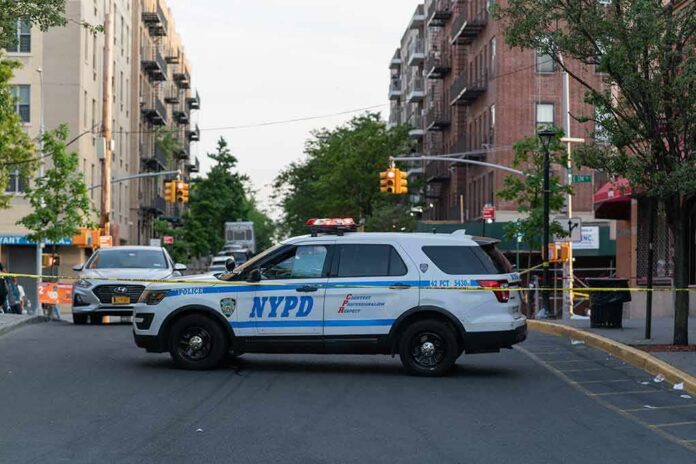
Just before 7:30 p.m. on Aug. 31, 2026, a 21-year-old man was stabbed at the intersection of West 50th Street and Fifth Avenue, an address whose civic and commercial weight — St. Patrick’s Cathedral on one corner, the flagship Saks Fifth Avenue on the other — turned an otherwise familiar street-dispute stabbing into instant citywide news. According to the New York Post, the attacker “punctured the man in the arm and torso” before fleeing; amNewYork’s account, sourced separately, describes the suspect having “slashed the victim on the arm and torso,” a variance in verb choice that reflects mediated reporting rather than any dispute about what actually happened.
EMS transported the victim to Bellevue Hospital, where he was listed in stable condition — a detail confirmed independently across the New York Post, amNewYork, and PIX11’s reporting, which is about as close to consensus as same-day crime coverage gets. No arrests had been made at the time these accounts were published, and the attacker’s description does not extend beyond the vehicle he escaped in: a black BMW. That gap — an unidentified suspect, an unrecovered weapon description beyond “sharp object” — is normal at this stage of an active investigation, not evidence that the reported facts are shaky.
How a Traffic Near-Miss Becomes a Stabbing
The mechanism police describe is unremarkable in its ordinariness, which is precisely what makes it worth understanding: the victim was crossing Fifth Avenue in a marked crosswalk when the driver of a black BMW nearly struck him. Words were exchanged. The confrontation escalated from there, ending with the driver producing a blade, wounding the pedestrian, and driving off before officers or bystanders could intervene. This sequence — near-collision, verbal dispute, sudden armed escalation — is the textbook shape of what’s colloquially called road rage, and it recurs with enough regularity in New York’s crime blotter that police and outlets alike now reach for the term almost reflexively.
What separates this incident from a garden-variety street fight is the speed of the escalation and the presence of a weapon carried, apparently, without premeditation tied to the specific victim. The attacker did not know the pedestrian; the confrontation was not personal until the traffic near-miss made it so. That distinction matters for how investigators classify the case and for how the public should read it: it is closer to an assault of opportunity born from anger than to a targeted or predatory attack, even though the injuries and the flight from scene carry the same legal weight either way.
The Broader Pattern: Most Slashings Aren’t Random
New Yorkers old enough to remember the 2016 spike in street slashings will recall then-Police Commissioner Bill Bratton’s public accounting of that year’s numbers: 567 attacks by late February, an average of nearly 11 a day, up 20 percent year over year — and, crucially, only seven of them involving genuinely random victims, with the overwhelming majority traced to fights, robberies, and domestic disputes. That ratio has held up as a durable description of the city’s stabbing landscape ever since: the raw count of blade attacks can rise or fall with the seasons and the headlines, but the underlying cause is almost always interpersonal, not indiscriminate.
This case slots neatly into that pattern, as does a separate road-rage stabbing reported in Queens, where a 47-year-old man was attacked at 126th Street and 26th Avenue after a “verbal dispute from some kind of traffic incident” turned violent — a near-identical mechanism to the Fifth Avenue case, just in a different borough and with a different victim. The consistency across these incidents is instructive: when New Yorkers worry about street violence, the statistically dominant risk isn’t the anonymous stranger with a knife but the driver who takes offense at being cut off, or the pedestrian who takes offense at nearly being hit.
The woman killed in an unprovoked stabbing Monday in Midtown Manhattan has been identified as a vice president in Bank of America ’s global corporate and investment bank division. https://t.co/0FWQPt0ADH
— Jack Harrington (@JackHarringto20) September 2, 2026
Why the Landmark Setting Shapes the Story — and Why It Shouldn’t
St. Patrick’s Cathedral and Saks Fifth Avenue did not cause this stabbing and had no bearing on why it happened; they are simply the fixed points New Yorkers and tourists use to orient themselves on a map, and outlets use them because a Midtown landmark address travels further than a bare street-corner citation. That’s a media incentive worth naming plainly, not because it distorts the facts of this case — the injuries, the hospital transport, the fleeing BMW are all corroborated across multiple outlets — but because readers should understand that the location’s fame inflates attention without inflating the underlying evidentiary record. The investigation remains open, and as with most no-arrest cases in this category, additional detail — the driver’s identity, the exact weapon, any surveillance footage from the Fifth Avenue corridor — will surface only as the NYPD’s inquiry progresses.
Sources:
nypost.com, pix11.com, bronx.news12.com