

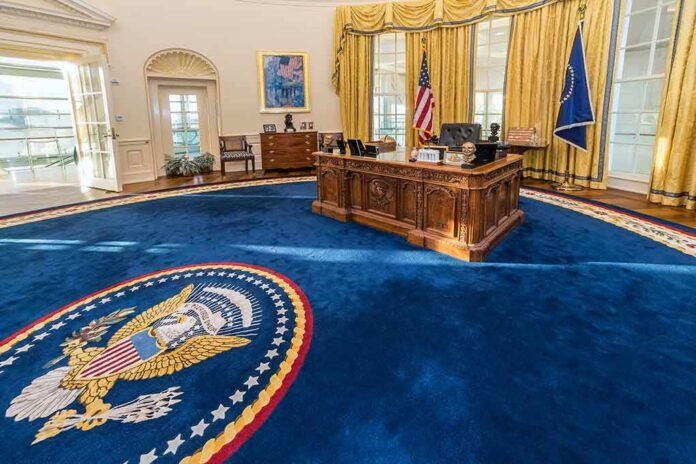
President Trump used the Antiquities Act to declare the Oval Office a national monument, tightening control over changes to the nation’s most symbolic workspace.
Story Snapshot
- Trump signed a proclamation creating the Oval Office National Monument under the Antiquities Act.
- The designation covers the Oval Office, Outer Oval Office, and the Cabinet Room.
- Interior officials must review major changes to protect historic character and integrity.
- Routine redecorating and security updates remain allowed under the proclamation.
What The Proclamation Does
On November 5, 2026, President Trump signed a proclamation that established the Oval Office National Monument. The order cites federal law known as the Antiquities Act. It defines the monument as the Oval Office, the nearby Outer Oval Office, and the Cabinet Room. It directs the Department of the Interior and the National Park Service to manage these rooms to protect their historic character, architecture, and ties to the presidency.
The White House also issued a fact sheet describing how officials must handle proposed changes. Before any substantial alteration or demolition, the government must document, review, and consider other options. Plans should match the national importance of these rooms. This creates a process checkpoint before major work can go forward. The aim is to prevent quick, sweeping changes to spaces that hold unique national meaning.
Scope, Limits, And Day-To-Day Use
The proclamation draws a line between historic preservation and normal operations. It says the president can still redecorate, select furnishings, and make ordinary operational or security updates that do not harm the rooms’ historic character. That means a sitting president may change rugs, drapes, art, or seating, as many have done, while major structural changes face added review. This balance tries to protect history without freezing a working office in time.
The document explains why these rooms qualify for protection. It notes the Oval Office design dates back to the early twentieth century. Presidents used its shape for ceremony and work. Later adjustments refined the space’s look and function. By placing the Oval Office and Cabinet Room under a monument framework, the proclamation argues that their history and design are objects of national significance that deserve care and continuity.
How This Fits Long-Running Power Fights
Presidents have long used the Antiquities Act to protect places fast, and successors have often tested how durable those choices are. Congress’s research arm reports that past presidents reduced some monuments many times, and the law does not clearly state whether a president can end a monument. That gray area leaves room for policy swings and legal debate over how far this power goes and how much later leaders can undo it.
President Donald Trump has signed a proclamation seeking congressional protection for the Oval Office and Cabinet Room, saying future presidents should need lawmakers' approval before making major structural changes.
The move follows Trump's own renovations at the White House,… pic.twitter.com/yvRqZeKXp6
— World Times (@WorldTimesWT) November 6, 2026
The fact sheet and proclamation do not name any current plan to demolish or overhaul these rooms. They set out a management process and assign duties to federal agencies. The materials do not change normal daily control of the workspace. They instead add checks on large changes. For readers who worry about sudden moves by elites behind closed doors, this action moves authority into a formal process with a paper trail and clear roles.
Why It Matters Across The Political Spectrum
For conservatives who fear that powerful insiders rewrite rules on a whim, this step sets guardrails for spaces that hold presidential history. For liberals who worry about executive overreach, the same step shows how one person can shape rules for public heritage with a single signature. Both views highlight a shared concern: Washington often acts first and sorts details later. The proclamation creates process, but its long-term force may depend on how future leaders interpret or modify it.
What To Watch Next
Key questions now turn on implementation. The Interior Department and the National Park Service must build the review system the proclamation requires. Their rules, timelines, and staffing will decide how strong the new guardrails are in practice. Legal analysts will also watch if future presidents test the edges of the Antiquities Act in the context of White House spaces, where separation of powers issues meet preservation law.
Sources:
thegatewaypundit.com, whitehouse.gov