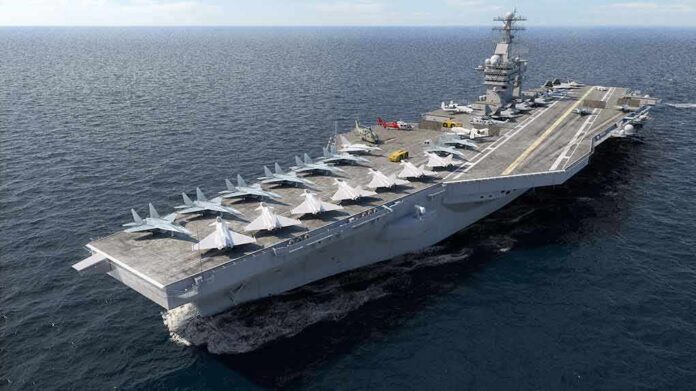
As China launches stealth jets from an electromagnetic catapult, President Trump has told the U.S. Navy to go back to steam.
Story Snapshot
- China’s Fujian carrier is operating electromagnetic catapults with multiple aircraft types.
- President Trump ordered future Ford-class carriers to use steam catapults, reversing course.
- The U.S. Navy says electromagnetic launches have improved and can boost sortie rates.
- The data on China’s catapult reliability and long-term performance remains limited.
What China Proved At Sea With Fujian
Chinese military outlets said the carrier Fujian launched and recovered several aircraft using an electromagnetic system. They named the J-15T fighter, the J-15DT electronic warfare jet, the J-35 stealth fighter, and the KJ-600 early warning plane. They said these flights tested full-deck operations and showed system compatibility across aircraft classes. Janes reported that China commissioned Fujian in November 2025 as its first carrier with an electromagnetic launch system, confirming the ship’s new role.
Reuters earlier tracked the carrier’s sea trials, which began in May 2024. Reporting described a focus on the ship’s propulsion and electric power reliability. Later coverage detailed multiple trial phases, including an intensive eighth trial ahead of commissioning. Fujian’s reported launches of a fixed-wing early warning plane matter. That aircraft extends radar reach well beyond helicopter models used on older Chinese carriers, which could change regional air control dynamics.
Trump’s Steam Order And The U.S. Navy’s Case For Electromagnetic
Army Recognition and other outlets reported that President Trump directed future Ford-class carriers to return to steam catapults, starting with USS Doris Miller (CVN-81). The reports called this a major engineering reversal, because the Ford class was designed around electric power systems. CNN noted that the newest U.S. carrier, USS Gerald R. Ford, uses an electromagnetic system, while the ten Nimitz-class ships still rely on steam.
Aviation Week reported the Navy’s public case that electromagnetic launches have improved. A four-star fleet commander said recent performance showed sortie rates between 120 and 130 percent of Nimitz-class levels. That claim backs arguments that the technology can support faster air operations. Still, the Navy’s path is now shaped by the President’s order. Designing back to steam could add cost, time, and risk to ships built for electric launch systems.
What We Know, What We Do Not, And Why It Matters
China’s claims about Fujian’s electromagnetic system come mostly from state or state-linked sources. These reports show aircraft launching and recovering, but do not share detailed failure rates or long-duration data. That limits independent checks on reliability and wartime tempo. Reuters and Janes confirm commissioning and trials, but they do not provide engineering metrics. The result is a verified capability with unclear depth of maturity and sustainment strength.
🇨🇳Type 004 Nuclear Update: Hull Exceeds 320 Meters
China’s nuclear-powered aircraft carrier is advancing fast at Dalian. Current hull already exceeds 320 meters, dual reactor structures confirmed, and electromagnetic catapults expected on a 110,000+ ton platform.
Blue-water… https://t.co/057kopaQdB pic.twitter.com/4vpzh7q1Gd
— GeoPaul626 (@Paull626) August 23, 2026
The crosscurrent is sharp. China is moving ahead with electromagnetic launch on a frontline carrier. The United States is debating a shift back to steam even as the Navy touts better electromagnetic results. Voters who worry about waste and drift in Washington see mixed signals. Industry and Pentagon leaders warn that redesigns can burn money and time. Families with service members want gear that works every time. Allies and rivals are watching which system the United States chooses next.
Sources:
19fortyfive.com, globaltimes.cn, eng.chinamil.com.cn, maritime-executive.com, forcesnews.com, strategypage.com, x.com, navylookout.com