
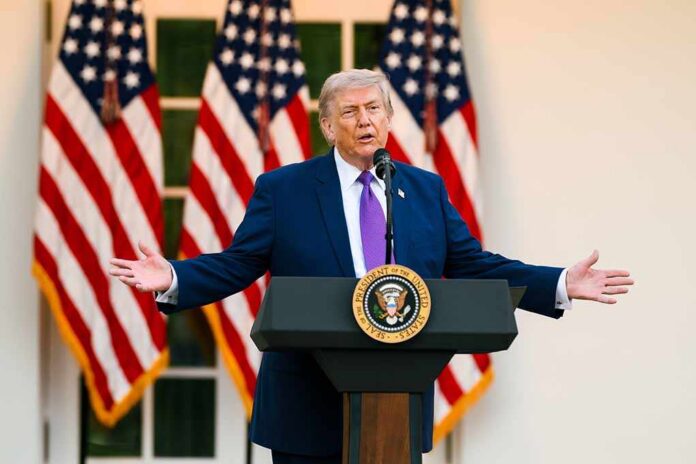
President Trump said divided government could deliver “a lot of great things,” especially on healthcare, even as he warns Democrats he will use the veto.
Story Snapshot
- Trump welcomed talks with Democrats who will control Congress in 2027, while brandishing veto power.
- He said bipartisan deals on healthcare are possible and might outperform talks with Republicans.
- News outlets project Democrats will run both the House and Senate after the 2026 midterms.
- History shows veto bargaining often shapes lawmaking when government is split.
What Trump Said After Democrats’ Midterm Sweep
President Trump told reporters he expects to work with Democrats after they won control of Congress in the 2026 midterms. He framed his veto as leverage, saying Democrats should see it as a “starting point” for making deals. He argued that cooperation could lead to strong outcomes, and that he might even be more productive with Democrats than he was with Republicans during the first half of his term. Major outlets projected Democrats will lead both chambers in January.
Trump singled out healthcare as a leading area for cross-party talks. He said there is a “real possibility” to get “a lot of great things done,” while stressing any plan would be a mix of ideas, not a full win for either side. That message offered a concrete policy focus and set terms for negotiation. It paired outreach language with a clear boundary: he would still reject bills he views as unacceptable, using the veto threat to shape any final deal.
Why Veto Power Matters In A Split Government
Political history shows that when one party holds the White House and the other runs Congress, the veto often becomes a tool to force talks and trade-offs. Presidents use it to steer bills closer to their goals, especially on must-pass items like budgets. Analysts note past presidents in similar binds used veto bargaining to win changes rather than accept a total loss, a pattern that could guide the coming fights over spending and health policy.
Research also finds that public calls for bipartisanship do not, by themselves, move many votes in Congress. Lawmakers tend to respond more to deadlines, public costs for failure, and clear policy details than to unity slogans. That means Trump’s upbeat tone may help set the stage, but specific offers, credible pay-fors, and looming timelines will likely decide whether any healthcare bill reaches his desk and earns his signature instead of a veto.
What A Bipartisan Health Deal Would Need
Healthcare deals in recent years have advanced when there was both a deadline and a narrow set of popular fixes. Policy trackers point to targeted steps that draw support in both parties, plus budget “offsets” to pay for them. In the next Congress, any package that trims costs, protects access, and avoids sweeping ideological changes will have the best odds. That structure fits Trump’s message: he wants “great healthcare,” but not a plan that gives one side everything.
For many Americans, this moment stirs mixed feelings. Voters on the right worry about higher costs, bigger government, and rules set by distant elites. Voters on the left worry about safety nets, the cost of care, and power tilting to the well-connected. Both sides see Washington’s habit of brinkmanship and spin. If leaders turn veto threats into honest bargaining and focus on concrete, paid-for fixes, they could prove the system still works. If not, gridlock will feed the sense that the government serves itself.
Sources:
youtube.com, rmb.reuters.com, nbcnews.com, cambridge.org, washingtonpost.com