
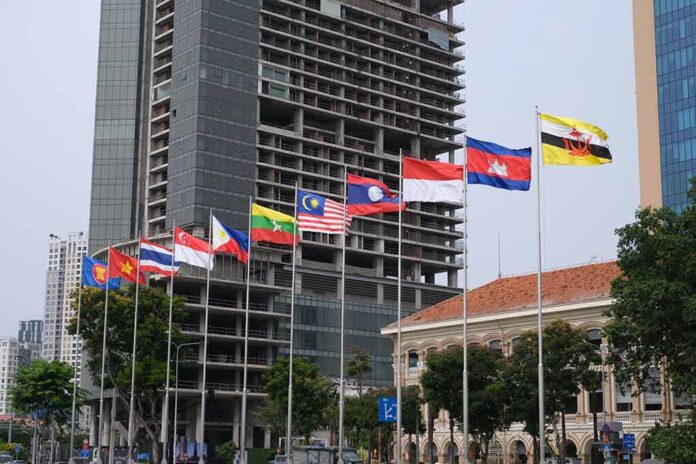
President Trump’s appearance at an ASEAN summit in Manila shows how high-stakes Indo-Pacific ties hinge on clear facts, not shifting headlines.
Story Highlights
- Trump attended a U.S.-ASEAN summit in Manila and delivered formal remarks.
- The White House recorded the date, venue, and purpose of his participation.
- U.S. statements emphasized peace, security, and a free and open Indo-Pacific.
- A White House trip brief listed joint statements released during the visit.
What The Official Record Shows About Trump’s Manila Summit
White House archives document President Trump’s participation at the 5th U.S.-ASEAN Commemorative Summit in Manila on November 13, 2017. The transcript places the event at the Philippine International Convention Center and records Trump addressing regional leaders. The record quotes him honoring the association’s role and setting a focus on peace, security, and a free and open Indo-Pacific. These details anchor what happened, when it occurred, and where it took place, using the administration’s own record.
A companion White House trip summary describes the broader outcomes tied to this Manila stop. The summary notes ASEAN’s 50th anniversary and 40 years of U.S.-ASEAN ties, a joint U.S.-ASEAN summit statement, and a separate joint statement with the Philippines on bilateral cooperation. These materials capture formal deliverables associated with the visit. They also show how the administration framed U.S. goals in Southeast Asia during that trip, with emphasis on security and economic cooperation.
Why The Manila Setting Still Matters In 2026
Southeast Asia sits at the center of trade lanes, energy routes, and defense plans that shape daily American life. Prices on store shelves, fuel costs, and job flows all tie back to stable sea lanes and fair market rules. When a U.S. president shows up, partners take the signal. The 2017 record shows a message about a free and open Indo-Pacific. That message resonates today as leaders again gather in Manila with similar security and trade concerns.
Americans across the spectrum worry about elite dealmaking that overlooks workers and small businesses. They also watch for costly wars, shaky supply chains, and energy shocks. U.S.-ASEAN engagement can help or hurt on each of these fronts. Strong rules for shipping and digital trade can lower costs. Clear defense ties can prevent crises that spike prices. The Manila summit materials show a push for these aims, which connect directly to pocketbook issues at home.
A Common Pitfall: Mixing Events And Dates
Recent coverage and social posts use different labels and dates for Trump’s ASEAN activity in Manila. Some refer to a “special summit” at a later date. The official White House transcript confirms the 2017 commemorative summit and Trump’s remarks there. Treating these as one event risks confusion about what occurred and when. The simplest fix is to tie claims back to the dated transcript and the trip summary that list location, purpose, and formal outcomes.
TRUMP MEETS ASEAN LEADERS
US President Donald Trump shakes hand with leaders of the regional bloc ahead of the ASEAN-US Special Summit on Tuesday night, Nov. 17. (🎥: ASEAN Philippines 2026) | via @HarleneDelgado pic.twitter.com/PCOcuRLmeG
— ABS-CBN News (@ABSCBNNews) November 17, 2026
Independent local reporting often previews or recaps summit schedules. Those pieces can add useful color, but they also may cite planned dates or evolving agendas. That can drift from final official records. When the goal is accuracy, the best anchor is the White House transcript for remarks and the official trip brief for outcomes. Readers should expect government to keep these basics straight; clear records help citizens judge real results, not spin.
Sources:
youtube.com, inquirer.com, arkansasonline.com