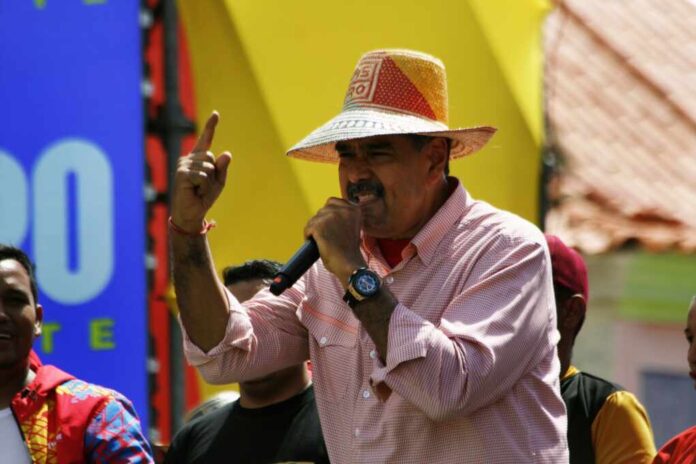
President Trump’s decisive military action in Venezuela stirs controversy, as allegations of civilian bombings emerge, challenging U.S. precision-strike claims.
Story Highlights
- Venezuela accuses the U.S. of bombing residential areas amid military strikes.
- President Trump confirms strikes targeting military sites, capturing Nicolás Maduro.
- The Venezuelan government declares a state of emergency, mobilizing military forces.
- International tensions rise as U.S. actions are labeled imperialistic aggression.
U.S. Strikes in Venezuela: Military Precision or Civilian Harm?
Early Saturday morning, U.S. forces executed a series of airstrikes in Caracas, Venezuela, targeting military complexes, including Fuerte Tiuna. President Trump authorized these strikes as part of a broader campaign against the Maduro regime, deemed a narco-mafia by U.S. authorities. However, Venezuelan Defense Minister Vladimir Padrino López accused the U.S. of bombing residential areas, framing the action as an imperialistic aggression against civilians.
The strikes, delayed from Christmas due to operational reasons, were part of “Operation Southern Spear,” aimed at dismantling drug trafficking networks. The U.S. claims to have executed precision strikes focused on military targets, yet reports from the ground indicate civilian areas were impacted, adding complexity to the narrative and raising questions about the operation’s legality and morality.
Watch:
Venezuelan Response and International Reactions
In the wake of the strikes, Venezuela declared a state of emergency, mobilizing military forces and calling its citizens to the streets in defiance of what they termed a cowardly attack. Nicolás Maduro’s capture was confirmed by U.S. officials, yet the Venezuelan government has not acknowledged this development. Globally, reactions vary, with some nations condemning the U.S. actions as unwarranted aggression, while others view them as necessary to combat the Maduro regime’s oppressive rule.
The capture of Maduro signifies a potential turning point in Venezuela’s political landscape, with U.S.-backed opposition figures poised to gain influence. However, the possibility of civilian casualties has sparked international debate, placing additional scrutiny on American foreign policy in Latin America. The implications for regional stability and U.S.-Latin American relations remain uncertain, as diplomatic tensions continue to simmer.
Strategic Implications and Future Prospects
The recent military engagement marks a significant escalation in U.S. involvement in Venezuela, shifting from previous naval operations to direct territorial strikes. This strategic shift underscores a commitment to dismantling the Maduro regime and curtailing its narco-trafficking operations. However, the potential for civilian harm necessitates a careful evaluation of military tactics and their alignment with international law.
For the Venezuelan populace, the strikes have heightened fears of further conflict and instability, as the government rallies support by portraying the U.S. as an aggressor. The situation’s complexity demands a nuanced understanding of regional dynamics, with potential long-term consequences for U.S. influence and credibility in Latin America.
Sources:
Venezuela Accuses USA of Bombing Residential Areas – CBS News
Venezuela Strike: Jets Target Maduro – WLRN
Venezuela Accuses US of Bombing Residential Areas – Vanguard