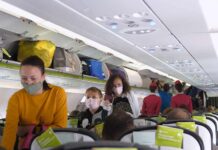

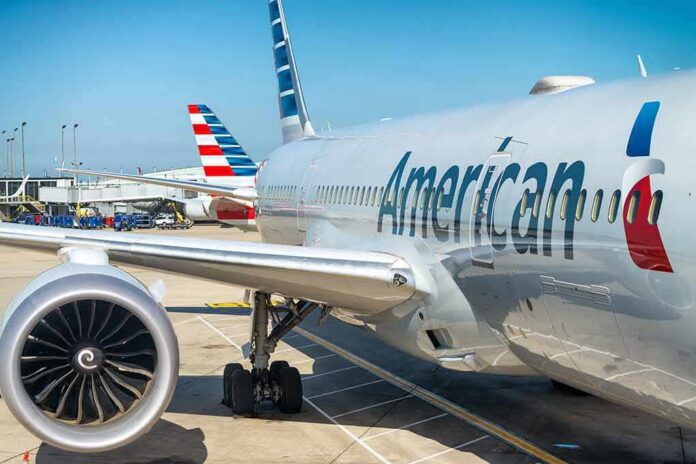
Passengers and crew tackled and restrained a man after police say he tried to manipulate an aircraft door, forcing an American Airlines flight to divert to Phoenix.
Story Snapshot
- Phoenix police say a passenger tried to manipulate an aircraft door mid-flight.
- American Airlines Flight 1494 diverted from its San Diego–Chicago route to Phoenix.
- Passengers and crew restrained the man until the plane landed safely.
- Witness video shows the struggle near the front of the cabin.
What Happened Onboard Flight 1494
Phoenix police said the man left his seat, moved to the front of the plane, ignored crew orders, and tried to manipulate an aircraft door on American Airlines Flight 1494 on November 25, 2026. The Chicago-bound flight had departed San Diego. The captain diverted to Phoenix, where the plane landed without further incident. Video taken by passengers shows several people on the floor near the forward galley holding the man down as the crew worked to secure him.
One passenger told local media the man yelled, “I want to see Jesus. Get me off this plane,” and tried to open more than one door before others stepped in. Another report from Arizona outlets described a traveler positioning himself between the man and the area near the cockpit until more help arrived. Police said crew members and passengers held the man until landing, when officers met the aircraft at the gate.
What Officials Say Versus Social Headlines
Police language matters here. The official description says “attempted to manipulate an aircraft door,” not a breach, cockpit entry, or a hijacking attempt. Some social posts and later write-ups framed it as an effort to force the cockpit door or “take over” the plane, but follow-up reporting narrowed that claim to the forward-cabin door area rather than the flight deck itself. That gap between precise police wording and dramatic headlines can shape how people view the risk.
Airlines and police often release limited facts while the Federal Bureau of Investigation (FBI) and prosecutors review possible charges. That creates space for short video clips and bold captions to spread faster than careful updates. In this case, the restraint video is real and striking. But it does not, by itself, prove intent to seize controls. It shows a struggle up front, which is serious, but not the same as a takeover.
Why This Matters For Every Flyer
Unruly-passenger cases remain a steady safety issue even after the post-pandemic peak. The Federal Aviation Administration (FAA) says airlines reported more than 1,500 such incidents by late 2026, and it continues to refer serious cases to the FBI. Diverting a flight is costly, risky, and disruptive for every traveler onboard. This is why flight attendants warn early, and captains land early, when someone ignores crew orders and moves toward key doors or the flight deck.
Many readers on the right and the left see a larger pattern: rules for regular people, and different rules for the connected. They worry that warnings come only after harm. This event shows something else, too. When systems feel distant or slow, regular people still step up. Passengers and crew acted within seconds and likely prevented worse outcomes. That is a reminder that community norms and quick action can still protect public spaces, even at 30,000 feet.
What We Still Do Not Know
Key facts remain open. Police have not released a charging document. Officials have not said which specific door was touched, what motions the man made, or whether any mechanism engaged. Reports differ on whether he reached for an exit or moved toward the cockpit door before being stopped. Without a completed investigation, it is not clear if prosecutors will pursue federal interference charges or a lesser offense. Claims beyond this are guesswork.
How To Think About Safety Claims
Experts often note that main cabin doors on pressurized jets cannot be opened in cruise due to design and pressure differences. Still, reaching for handles in flight can trigger panic, distract crew, and pose real danger during climb or descent. The safer move is to treat any attempt to manipulate doors as an immediate threat to order. That is why the crew diverted, and why law enforcement met the plane, even without proof of a near-open door.
Bottom Line
The facts we have are firm enough: a man moved forward, ignored orders, and tried to manipulate a door; passengers and crew restrained him; the plane diverted and landed safely in Phoenix. The “takeover” talk goes beyond what officials have said. Focus on what is documented, not the hype. Demand clear updates from police, airlines, and the FAA. That is how the public keeps pressure on systems that too often ask for trust without offering timely facts.
Sources:
thegatewaypundit.com, azfamily.com, wfsb.com, paddleyourownkanoo.com, abc7.com, yahoo.com