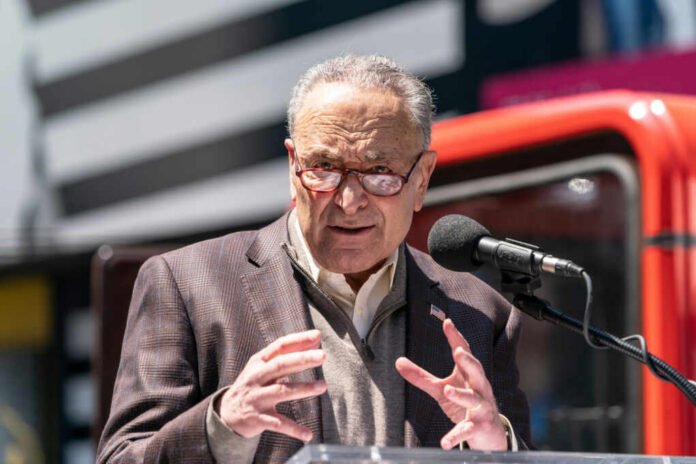
Chuck Schumer’s blunt shutdown comment—“Every day gets better for us”—handed the White House a rare, clear-cut opening to argue Democrats are treating Americans’ pain like a campaign strategy.
Quick Take
- Sen. Chuck Schumer told Punchbowl News the shutdown was politically beneficial for Democrats, prompting a sharp White House rebuke.
- The Trump White House framed Schumer’s remarks as evidence Democrats are prioritizing political leverage over federal workers and military families.
- The standoff centers on funding and health-care-related demands, with both sides trying to win the public blame game ahead of the 2026 midterms.
- Uncertainty around backpay for furloughed workers has raised the stakes and intensified pressure for a deal.
Schumer’s shutdown quote collides with real-world fallout
Senate Minority Leader Chuck Schumer (D-NY) drew fresh backlash after telling Punchbowl News that the ongoing government shutdown was advantageous for Democrats, saying, “Every day gets better for us.” The remark landed as many Americans were watching the consequences of a funding lapse—furloughed federal employees, service disruptions, and mounting anxiety for households living paycheck to paycheck. In a shutdown, the political messaging may shift daily, but the costs to families are immediate.
White House officials responded by calling Schumer’s statement “disgusting and revealing,” arguing it showed Democrats were comfortable letting pressure build on ordinary Americans to gain leverage in Washington. President Donald Trump echoed that line in public remarks, accusing Schumer and Senate Democrats of holding the government “hostage” to force their demands. That exchange hardened partisan lines at a moment when many voters—left and right—say they’re tired of politicians using crisis tactics instead of budgeting responsibly.
What the funding fight is really about: leverage, health care, and immigration politics
The standoff is tied to disputes over federal funding and health-care policy, with Democrats seeking protections and Republicans resisting spending or policy changes they see as expanding government or rewarding illegal immigration. The White House response to Schumer specifically highlighted a claim that Democrats were pushing for “free health care for illegal aliens,” an argument designed to connect the shutdown fight to border security and taxpayer priorities. Democrats, meanwhile, have leaned on health-care costs to frame Republicans as the obstacle.
Because Republicans control the House and Senate in Trump’s second term, Democrats’ most meaningful leverage is procedural and political: slowing Senate action, shaping media coverage, and betting that public frustration lands more heavily on the party in power. That incentive structure is one reason shutdown showdowns keep returning, even though both parties publicly say they want the government reopened. The core dispute becomes less about a clean funding bill and more about who can force concessions without absorbing the blame.
Backpay uncertainty raises the pressure on federal workers and the public
The shutdown’s human impact is not abstract. Furloughs can squeeze families quickly, and disruptions can ripple into travel and public services. Adding to the tension, the Office of Management and Budget floated the idea of no backpay for furloughed federal employees—an idea that would break with expectations formed after prior shutdowns, when backpay became the norm. Even the possibility of that outcome changes behavior: workers cut spending, communities brace for reduced commerce, and political anger deepens.
Why this moment feeds broader “government failure” concerns on both sides
Schumer’s quote is politically potent because it appears to confirm a cynicism many Americans already hold: that Washington’s leadership class is too willing to turn basic governing into a high-stakes game. Conservatives hear it as proof that Democrats will tolerate collateral damage to advance a narrative about health care and “Republican intransigence.” Many liberals, even while opposing Trump’s agenda, still see shutdowns as an elite-driven dysfunction that punishes workers while elected officials keep their salaries and platforms.
For the Trump administration, the episode also reinforces a broader argument that limited government only works when Congress can pass budgets on time and stop using emergency deadlines as bargaining chips. For Democrats, the risk is that an admission of political benefit—accurate or not—looks callous against the backdrop of strained household budgets. Either way, the shutdown fight is becoming a test of whether leaders can move from messaging warfare to basic competence: fund the government, settle disputes transparently, and stop treating citizens like leverage.
Sources:
White House slams Schumer’s ‘disgusting’ statement on shutdown as political standoff continues
Top US Democrat slams Trump’s $200M White House ballroom project