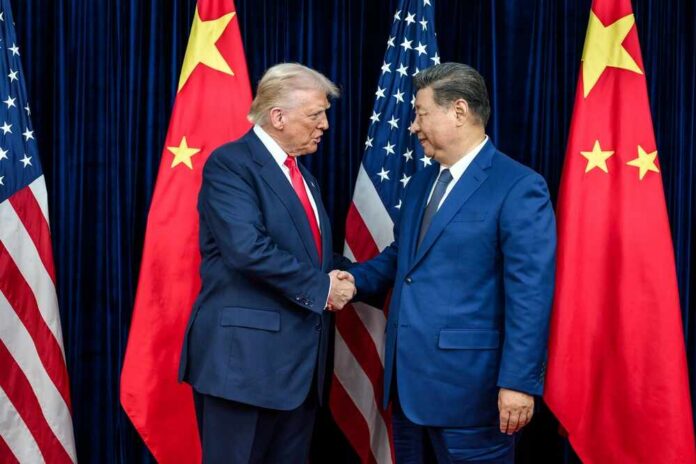
Despite optimistic summit rhetoric in South Korea, a dangerous technological and economic confrontation between the United States and China threatens to fracture the global economy while neither nation’s leaders appear willing to back down from a collision course that could devastate American workers and consumers.
Story Snapshot
- Trump and Xi agreed to tariff cuts and increased Chinese soybean purchases at May 2026 Busan summit, but experts warn “dangerous game of chicken” continues beneath surface
- Over 1,000 Chinese companies now on US Entity List as semiconductor export restrictions intensify, with Washington officials divided on whether curbs protect national security or accelerate Chinese innovation
- China controls rare-earth supplies and can weaponize soybean purchases, creating asymmetric leverage against Trump’s political base while Beijing pushes domestic chip alternatives
- Both economies remain dangerously interdependent despite decoupling rhetoric, with US tech companies dependent on Chinese markets and China reliant on American semiconductor technology
Summit Masks Deepening Economic Warfare
President Trump rated his May 2026 meeting with Chinese President Xi Jinping in Busan, South Korea as a “twelve” on a scale of zero to ten, announcing tariff reductions and increased Chinese soybean purchases. Industry experts and Peterson Institute analysts immediately contradicted the positive spin, warning that major trade conflicts continue simmering beneath diplomatic pleasantries. Both sides paused planned escalations while maintaining full retaliatory capacity, creating what observers describe as fragile stability that could collapse at any moment. The agreements addressed surface-level trade issues while fundamental technological competition and strategic rivalries remain unresolved.
Semiconductor Showdown Threatens American Tech Dominance
Washington continued curbing semiconductor exports to China throughout 2025-2026, with Beijing responding by intervening in its largest chipmaker’s output to prioritize domestic firms like Huawei. The Trump administration avoided discussing new chip export restrictions with Xi after receiving security warnings, exposing internal divisions among officials. Some argue restrictions are vital to prevent Chinese military advancement, while others including Nvidia CEO Jensen Huang warn that shutting China out completely could hurt American companies and paradoxically accelerate Chinese innovation. Over 1,000 Chinese companies now appear on the US Entity List, creating a scramble for chip capacity and resources across China’s artificial intelligence industry.
China’s Counter-Leverage Exposes American Vulnerabilities
Beijing has quietly and methodically assembled increasingly effective economic weapons against American pressure. China’s tight control over rare-earth supplies essential for advanced manufacturing revealed critical US industrial vulnerabilities that decades of globalist policies created. Chinese cutoffs of soybean purchases directly threaten Trump’s agricultural base in politically sensitive Midwestern states, demonstrating how economic interdependence works both ways. Beijing retaliated against US restrictions on entity-list company subsidiaries while maintaining the ability to yank back trade concessions at any time. This counter-leverage strategy reflects strategic patience as China pursues technological self-sufficiency through domestic semiconductor development and alternative AI architectures.
Technology Bifurcation Signals New Cold War Reality
The semiconductor and artificial intelligence competition represents a fundamental strategic rivalry that transcends traditional trade disputes, with both nations racing toward incompatible technology ecosystems. US officials documented how Chinese law requires companies to share technology with the military under penalty, validating national security concerns about dual-use technology. China’s “Made in China 2025” initiative explicitly targets dominance in advanced manufacturing and AI, directly challenging American technological supremacy. Export restrictions now extend beyond semiconductors to visa policies for Chinese STEM researchers and Chinese investments in American tech startups, while Washington lobbies allies to exclude Chinese telecommunications equipment. The resulting fragmentation creates inefficiencies and higher costs while potentially spurring competing global technology standards that reflect geopolitical rather than technical considerations.
American Workers Caught in Crossfire of Elite Maneuvering
The Trump-Xi confrontation exposes how ordinary Americans bear the costs of failed policies by both Republican and Democratic administrations. Decades of misguided globalization allowed China to build asymmetric leverage over critical supply chains while hollowing out American manufacturing. Tech workers now face job insecurity dependent on export policies determined by Washington bureaucrats, while farmers remain vulnerable to Chinese retaliation that treats agricultural products as geopolitical weapons. Consumers pay tariff-inflated prices on electronics and consumer goods while corporate executives and government officials maintain comfortable positions regardless of outcomes. Neither the Trump administration’s confrontational approach nor previous administrations’ engagement strategy addressed the fundamental problem: an economic relationship built on mutual vulnerabilities that neither nation can escape without significant pain, leaving working families to suffer the consequences of elite decision-making.
Sources:
Trump-Xi summit hides simmering trade tensions under surface, industry experts say
Experts react: What does the Trump-Xi meeting mean for trade, technology, security, and beyond?
China-US relations and the future of international order