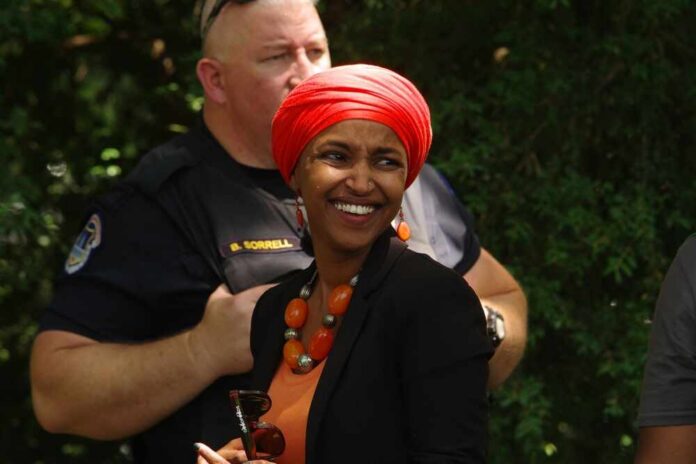
Rep. Ilhan Omar’s insistence she’s “not a millionaire” is colliding head-on with financial paperwork showing a sudden jump in household assets—exactly the kind of Washington transparency gap that fuels public distrust.
Quick Take
- Omar has publicly rejected claims that she is worth millions, calling the narrative “ridiculous,” even as disclosures show a dramatic change in reported household assets.
- House financial disclosures list Omar and her husband’s joint assets as high as $6 million to $30 million in 2024, up sharply from a much smaller range the year prior.
- House Oversight Chair James Comer is seeking records tied to Omar’s husband, Tim Mynett, and his firms, including audits, SEC communications, and certain international travel.
- The controversy highlights how broad disclosure ranges and self-reported valuations can inflame suspicion—without proving wrongdoing.
What Omar’s disclosure shows—and why the numbers triggered backlash
Rep. Ilhan Omar (D-Minn.) is facing renewed scrutiny after reports highlighted a sharp swing in her household’s reported wealth. Public filings show that a 2024 financial disclosure listed joint assets with husband Tim Mynett in a range of roughly $6 million to $30 million, compared with a 2023 filing listing far less. The largest reported component involves Mynett’s stake in Rose Lake Capital, valued in the millions by the disclosure’s range system.
Omar’s pushback has been emphatic. In a 2025 interview, she called the claim she is worth millions “ridiculous” and “categorically false.” Separate coverage also describes her attributing the apparent spike to reporting mistakes, including a “tax filing error.” What remains unresolved is the core question voters usually care about: whether the reported values reflect real wealth, a paperwork problem, or valuation assumptions that look dramatic in the House’s wide reporting bands.
How House disclosures can obscure the truth while still being “accurate”
Congressional disclosures are required, but they are not a bank statement and they do not provide precise net worth numbers. The forms often use broad ranges—designed partly to protect privacy—so an asset can be listed as worth anywhere from a small bracket to a large one. That structure can make normal changes appear explosive, especially when a business interest moves from a low bracket to a multi-million bracket without additional detail about revenue, buyers, or independent valuation.
That ambiguity is the accelerant in this story. Conservatives see a system that lets powerful officials and their families operate behind a fog of ranges and self-reporting, then dismiss questions as “disinformation.” Many liberals, meanwhile, argue that right-leaning outlets and Republican investigators use those same ranges to imply scandal before evidence is presented. Both sides are reacting to the same problem: Americans are asked to trust institutions that often cannot—or will not—show their work.
What Comer is investigating—and what is (and isn’t) proven so far
House Oversight Chair James Comer (R-Ky.) has launched an inquiry tied to Mynett and his business entities, requesting documents related to audits, communications with the Securities and Exchange Commission, and certain travel involving the UAE, Somalia, and Kenya, according to reporting. Comer has also raised concerns about whether “unknown individuals” might be investing for influence. As of early 2026 coverage, the inquiry was active, but public reporting did not describe charges or definitive findings.
That distinction matters for responsible readers. Oversight letters and media headlines can signal legitimate red flags, but they are not proof of fraud by themselves. The available reporting also notes that Trump publicly amplified the issue on social media, at times citing figures higher than what the disclosure ranges show. The most solid, verifiable baseline remains the disclosure’s stated brackets and the fact that, so far, no amended filing or conclusive public accounting has been detailed in the research provided.
Why this resonates in 2026: trust, “elite” privilege, and unequal rules
For many voters—especially older Americans who have watched prices rise and confidence in institutions fall—the anger is less about one lawmaker and more about a pattern. Americans see aggressive enforcement when ordinary people make paperwork mistakes, but endless gray zones when political power is involved. When an elected official can deny being “worth millions” while official forms show multi-million-dollar brackets, it reinforces the sense that Washington plays by different rules than everyone else.
Ilhan Omar: Hey, Um, As It Turns Out, I'm Not Actually A Multimillionaire After All https://t.co/YHrrwXcFps
— zerohedge (@zerohedge) April 18, 2026
The best-case outcome is clarifying transparency without turning oversight into a partisan weapon. If Omar’s explanation is accurate, then clean documentation and, if needed, an amended filing would help restore trust. If investigators find evidence of improper influence or false reporting, then enforcement should be swift and equal to what regular citizens face. Either way, the larger issue remains: broad disclosure ranges and limited verification keep feeding the belief that government protects insiders first.
Sources:
Omar claims she’s not a millionaire amid net worth increasing up to $30 million: report
Comer probes sudden wealth jump tied to Ilhan Omar’s husband, eyes link to Minnesota fraud
Fact Check Team: Omar’s finances sparks broader debate on congressional wealth ethics