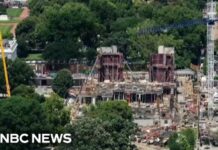

A federal judge just drew a sharp line at the White House: national security upgrades can keep moving, but President Trump’s planned ballroom must stop—at least above ground.
Quick Take
- U.S. District Judge Richard Leon clarified that below-ground, security-related work at the East Wing site may proceed even as above-ground ballroom construction remains blocked.
- The decision follows a preservationist lawsuit arguing the $400 million project lacks required congressional approval.
- The D.C. Circuit ordered Leon to explain how a halt could affect security, extending a stay that runs to April 17 and leaving room for a Supreme Court appeal.
- Leon rejected the administration’s argument that “safety-and-security” concerns justify the entire project, saying national security is not a “blank check.”
Judge Leon’s Clarification: Dig for Security, Not for a Ballroom
U.S. District Judge Richard Leon’s latest clarification keeps the ballroom fight alive while allowing the White House to address subterranean security needs. Leon had previously halted above-ground construction tied to President Donald Trump’s proposed 90,000-square-foot, $400 million White House ballroom, citing a likely lack of congressional authorization. On Thursday, he specified that below-ground work tied to security—such as fortified installations and medical capabilities—can proceed, while non-security above-ground work remains barred.
Leon’s order also tried to prevent gamesmanship. He allowed limited above-ground steps only to secure and cover the site, not to advance the event-space build. That split matters because it signals the court is willing to treat “security” as a narrow exception rather than a broad umbrella. For voters already skeptical of Washington’s habit of stretching legal authorities, the judge’s approach underscores a basic principle: emergency claims do not erase oversight.
Why the Appeals Court Stepped In and What Happens by April 17
The U.S. Court of Appeals for the D.C. Circuit pushed the case forward by demanding clarity on national security consequences. After Leon’s March 31 ruling pausing above-ground activity (while carving out security needs), the appeals court directed him to explain whether the injunction itself could create unacceptable vulnerabilities. The panel extended a stay that allows time for further review through April 17, leaving the administration an opening to seek Supreme Court intervention.
The appellate record shows a real dispute about whether the security elements and the ballroom structure can be separated in practice. Administration lawyers argued the project is “inseparable,” warning that delays prolong risks to the President, staff, and the complex. Leon, after reviewing sensitive submissions, did not accept that the security rationale automatically validates the entire plan. He instead treated security work as permissible only to the extent it can be distinguished from the halted above-ground construction.
The Core Legal Fight: Who Controls White House Changes—Congress or the President?
At the heart of the lawsuit is a familiar separation-of-powers question: what a president can build on the White House grounds without clear congressional approval. Preservationists sued to block the project, arguing no statute gives the president unilateral authority for a major above-ground addition of this scale. Leon indicated the plaintiffs are likely to succeed on the merits, which is why he originally stepped in. That legal posture helps explain why he kept the ballroom portion on ice.
The appeals court proceedings also reveal how reasonable people can read the same legal framework differently when security is invoked. A dissent by Judge Neomi Rao highlighted a statute that can be read to allow presidential improvements to the White House and emphasized security harms over “aesthetic” ones. The majority, however, wanted more explanation about how the pieces fit together. The unresolved tension is exactly what often frustrates Americans: big decisions hinge on process and jurisdiction, not just outcomes.
Security vs. Symbolism: What This Episode Says About Government Trust
The public-facing debate is about a ballroom, but the underlying conflict is about credibility and boundaries. Conservatives who have watched federal agencies expand their reach hear “not a blank check” and think of overdue constraints on bureaucracy and executive overreach alike. Liberals wary of Trump’s use of executive power see judicial enforcement of congressional authority. Either way, it reinforces a shared fear across the electorate: government leaders too often treat rules as optional until a court intervenes.
Judge who halted White House ballroom construction allows national security work to proceed at site https://t.co/H9BOpkOv5H
— The Washington Times (@WashTimes) April 17, 2026
Practically, Leon’s clarification delivers a split outcome. The White House can proceed with underground measures intended to address modern threats—while the higher-profile, above-ground event space remains paused and potentially headed toward a Supreme Court showdown. The next steps will hinge on how quickly the administration appeals and whether higher courts accept the argument that the security components cannot realistically be separated from the structure above. Until then, the project sits in a legal holding pattern.
Sources:
Trump White House Ballroom: Judge who halted construction allows national security work to continue
Appeals court national security White House ballroom construction halt