Iran’s top military adviser is openly threatening to sink U.S. Navy ships in the Strait of Hormuz—an energy choke point where one misread warning could ripple into higher gas prices at home.
Quick Take
- Iranian adviser Mohsen Rezaei said Iran would sink U.S. ships if Washington tries to “police” the Strait of Hormuz.
- U.S. officials say American destroyers have transited the strait without incident, while Iranian media claim a U.S. vessel was warned off—accounts that conflict.
- Hormuz is a narrow corridor tied to roughly a fifth of global oil flows, making even rhetorical escalation economically consequential.
- Analysts and maritime advisories warn Tehran can lean on asymmetric options, including proxy pressure at other chokepoints.
Rezaei’s Threat Raises the Temperature in a Critical Waterway
Mohsen Rezaei, a former IRGC commander recently appointed as a senior military adviser to Iran’s Supreme Leader, delivered the blunt warning on Iranian state television on April 15, 2026. Rezaei said U.S. vessels in the Strait of Hormuz “can definitely be exposed” to Iranian missiles and framed any American effort to “police” the waterway as a red line. The messaging centered on deterrence through intimidation, not diplomacy.
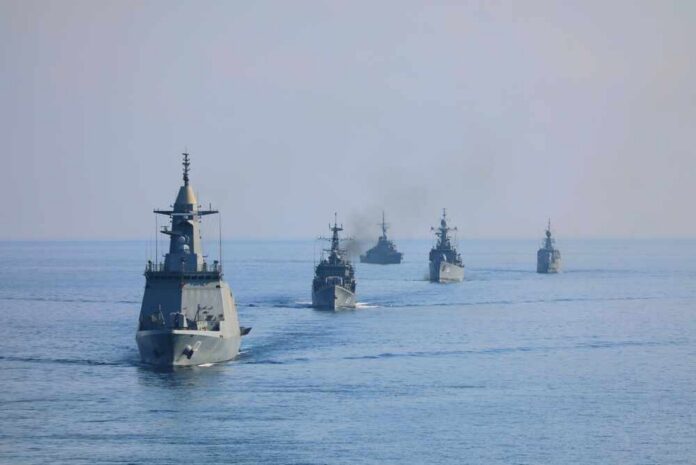
President Trump’s administration has maintained a visible naval posture in and around the strait, describing U.S. activity as protecting freedom of navigation and pressuring Tehran after a broader regional conflict. Trump has also publicly argued Iran’s conventional capabilities have been degraded, while Iranian state-linked outlets portray the U.S. presence as a provocation. The result is a familiar pattern: Tehran talks as if it controls the chessboard, Washington insists it can sail where international law permits.
Conflicting Claims About U.S. Transits Highlight Fog-and-Friction Risk
Reporting around the most recent movements underscores how quickly narratives can diverge in a high-stakes environment. U.S. officials have indicated guided-missile destroyers transited the Strait of Hormuz without disruption. Iranian media, however, has claimed a U.S. vessel reversed course after receiving a warning that an attack could follow within minutes—an assertion disputed by American accounts. Without independent verification, the public is left parsing competing statements rather than confirmed facts.
That uncertainty matters because the danger is often less about a declared intention than about miscalculation. A threat broadcast for domestic consumption can be interpreted as an operational signal. A routine transit can be portrayed as a “test” that demands a response. In an era when governments and aligned media channels push real-time narratives, commanders have less room to quietly de-escalate without looking weak. Even if neither side wants a shooting war, the cycle of warnings and denials raises the odds of a mistake.
Why Hormuz Still Hits Americans in the Wallet
The Strait of Hormuz is only about 21 miles wide at its narrowest point, yet it carries an outsized share of global energy traffic—often estimated around 20% of the world’s oil. That makes the strait more than a distant foreign-policy headline. Any credible disruption threat can move markets, raise shipping insurance costs, and feed energy-price volatility that American families notice quickly. Conservatives who have long criticized policy-driven energy scarcity see this as a reminder that hard power still shapes “cost of living.”
Iran’s leverage is not limited to a direct naval clash. Research and security reporting frequently point to asymmetric tools: missiles, mines, drones, and the use of proxy groups to threaten shipping beyond Hormuz. Recent expert commentary has also warned of “multi-chokepoint” pressure—creating risk in multiple corridors at once so the West has to spread resources thinner. The U.S. Navy can protect lanes, but it cannot make global trade immune to political violence, especially when adversaries prize chaos as a bargaining chip.
Domestic Politics, “Deep State” Distrust, and the Demand for Clear Objectives
Trump’s second-term posture—projecting strength, defending navigation, and challenging Tehran’s regional network—lands differently across a polarized America. Many conservatives support decisive deterrence but remain wary of open-ended commitments after decades of costly wars. Many liberals criticize militarized responses yet also fear economic fallout from instability. Across both camps, distrust of federal institutions and opaque decision-making persists, especially when briefings are classified and media accounts conflict. When the public senses gamesmanship, skepticism grows.
The immediate question is whether the latest threats stay rhetorical or evolve into actions that force a response. For Americans trying to budget in an inflation-sensitive era, the practical takeaway is simple: energy chokepoints remain a national security issue, and clarity of mission—what “policing” means, what triggers retaliation, and how escalation is avoided—matters as much as firepower.
Sources:
Iran Military Adviser Threatens to Sink US Ships if Washington ‘Polices’ Hormuz
Iran news article (Jerusalem Post) on Strait of Hormuz tensions and disputed transit claims
Gate of Tears risk: Iran threatens major global chokepoint as U.S. moves in Hormuz