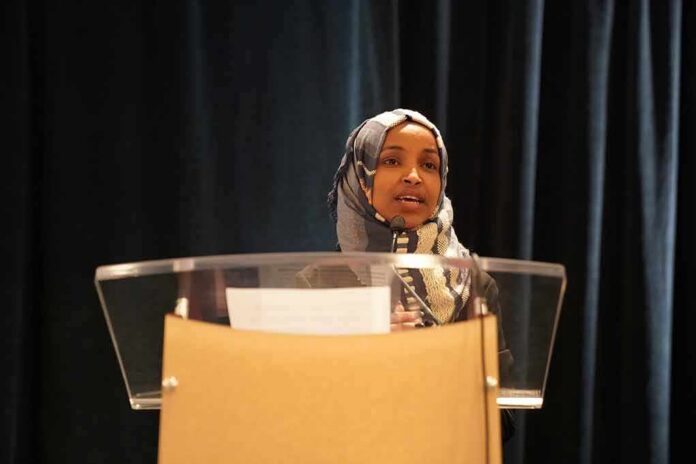
Representative Ilhan Omar introduced a bill to redirect about $140 billion from federal immigration enforcement to local recovery grants tied to recent raids.
Story Snapshot
- Omar’s Make ICE Pay Act aims to divert nearly $140 billion from enforcement to community grants.
- The bill responds to “Operation Metro Surge” in Minnesota and other large raids.
- Funds would flow to states, cities, schools, nonprofits, and small businesses hit by operations.
- The plan challenges how Congress set long-term funding for enforcement in recent laws.
What Omar’s Bill Would Do With the Money
Representative Ilhan Omar said the Make ICE Pay Act would block and redirect about $140 billion that Congress set aside for Immigration and Customs Enforcement and Customs and Border Protection. Her office describes a grant program for states, cities, schools, nonprofits, and small businesses that face costs after large enforcement actions. The measure frames the shift as recovery aid for affected communities, not as a general budget cut to unrelated federal programs.
Omar’s materials and allied summaries describe the grants as paying for property damage, lost wages, legal support, and local public safety needs tied to enforcement surges. They also point to the goal of stabilizing neighborhoods after major raids, which can shut down worksites, disrupt families, and strain local services. Supporters say the money comes from the same pool Congress already dedicated to immigration enforcement in recent national spending bills.
Why This Fight Matters in Today’s Budget Landscape
Congress recently passed multi-year funding that locked in large sums for border and immigration enforcement. Analysts estimate more than one hundred seventy billion dollars in added enforcement-related money across the Department of Homeland Security and other agencies under the so-called “One, Big Beautiful Bill.” Omar’s plan directly challenges that approach by recasting enforcement funds as community recovery dollars when local costs spike after federal operations.
Government watchdogs and policy researchers have tracked years of fights over how immigration money moves after Congress sets totals. The Department of Homeland Security has used transfers and reprogramming within its accounts to cover detention and operations. The Government Accountability Office reported that the department notified Congress about plans to move about one point eight billion dollars over a decade to meet Immigration and Customs Enforcement needs. Those moves fuel debates about control and oversight.
The Trigger: Minnesota’s “Operation Metro Surge”
Omar tied the bill’s timing to the end of “Operation Metro Surge” in Minnesota, a recent enforcement push. Her office says communities faced damage and costs during that surge and should have a clear way to get paid back. Minnesota Representative Angie Craig joined in promoting the reimbursement model, highlighting state and local bills that follow federal actions. Their joint messaging places the burden of local recovery on federal dollars linked to the operations themselves.
Rep. Ilhan Omar's Make ICE Pay Act Would Divert $140 Billion to Communities and Nonprofits https://t.co/NrFN2nb2tP
— Marlon East Of The Pecos (@Darksideleader2) September 20, 2026
The proposal would have the Department of Housing and Urban Development run the grant program, according to advocacy write-ups and press materials. That design leans on a department already used to channeling aid to cities and community groups. It also shifts recovery from ad hoc charity or local taxes to a federal stream tied to the cause of the costs. Backers argue this makes the system more fair and more transparent for families and businesses in the path of raids.
How This Lands With Voters Across the Spectrum
Conservatives who want strong borders see the bill as a risk to agents, detention capacity, and deportations. Liberals who worry about civil rights and family stability see a chance to repair harm after surges. Many Americans of all stripes, tired of budget games in Washington, will focus on accountability. The plan asks whether money set aside for enforcement should also cover the fallout that enforcement creates in towns and schools during large operations.
What Comes Next in a Republican-Led Congress
President Trump sits in the White House, and Republicans control both chambers. That makes passage of a large redirection of enforcement funds an uphill climb. Still, the bill plants a marker in the budget talks that will shape the next Department of Homeland Security appropriations cycle. Even without full passage, pieces of the idea—like formal reimbursement lines—could appear in negotiations or oversight language as lawmakers revisit transfer and reprogramming rules.
Sources:
twitchy.com, omar.house.gov, quiverquant.com, congress.gov, americanimmigrationcouncil.org, gao.gov