
New York City’s newest “racial equity” push is being used to justify higher taxes and a planned reduction of roughly 5,000 NYPD positions—an approach that has many residents wondering whether ideology is driving policy more than public safety and affordability.
Quick Take
- Mayor Zohran Mamdani released a 375-page “Preliminary Racial Equity Plan” citing a racial wealth gap of more than $180,000 between White and Black households.
- The plan frames disparities as the result of systemic racism and calls for city agencies to evaluate work through a racial equity lens.
- Mamdani’s broader agenda includes higher taxes on top earners and corporations, paired with expansive new programs and a major NYPD staffing reduction.
- Several of the proposed tax changes require state approval, and Gov. Kathy Hochul has opposed tax increases.
What Mamdani’s plan says—and why the wealth-gap figure matters
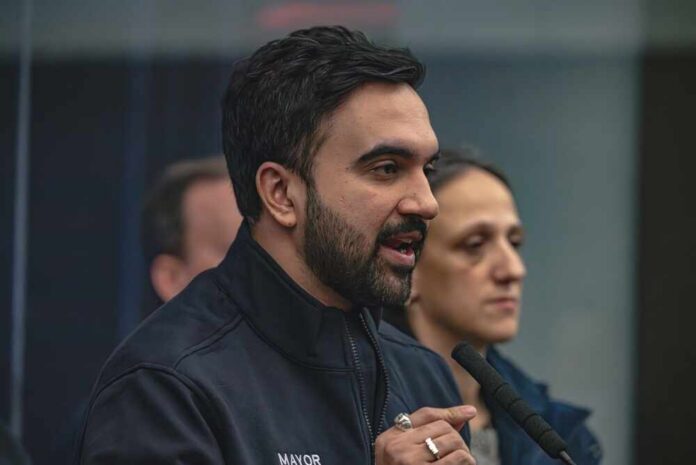
New York City Mayor Zohran Mamdani rolled out a 375-page “Preliminary Racial Equity Plan” that points to a wealth gap exceeding $180,000, with the plan citing median wealth over $200,000 for White households and less than $20,000 for Black households. Mamdani described the document as an indictment of “policies and politics that have persisted for far too long,” while insisting it is not an indictment of individual New Yorkers. A 30-day public comment period is now underway.
WTF IS THIS GUY SMOKIN ⁉️#NYC IS DOOMED 2 FAIL.
NYC mayor cites $180K racial wealth gap to justify taxes, police cutshttps://t.co/TCF2XqAGCU
— Beachlvr213 (@beachlvr213) April 13, 2026
The plan is significant because it ties a specific, headline-grabbing statistic to a governing framework that would steer multiple agencies toward race-based benchmarks in areas like the economy, housing, and public safety. Supporters see that as overdue accountability; critics see it as a bureaucratic mandate that can reorder city priorities without clear proof the new approach will improve day-to-day life. The plan’s own wealth data is presented via a report referenced within the document, not independently detailed in the coverage.
Taxes, spending, and the risk of squeezing the productive economy
Mamdani’s equity blueprint overlaps with a larger agenda estimated at $127 billion, including campaign-style proposals such as free buses, city-owned grocery stores, rent freezes, and a minimum-wage increase to $30 per hour within four years. To fund it, he has floated raising corporate taxes to match New Jersey’s 11.5% rate—projected to raise about $5 billion—and imposing a 2% flat tax on the top 1% earning over $1 million annually.
Some of those revenue measures would require Albany to sign off, giving state leaders major leverage over what becomes law and what remains a wish list. Gov. Kathy Hochul’s reported opposition to tax hikes adds uncertainty, and that uncertainty matters because city budgets don’t wait for political fights to resolve. When government expands promised benefits faster than it can lock in reliable revenue, the pressure often shifts to property taxes, fees, and service levels that hit middle-class households and small businesses first.
Public safety flashpoint: cutting about 5,000 NYPD positions
The most politically explosive element is the planned reduction of roughly 5,000 NYPD positions, presented alongside the broader equity agenda. For many New Yorkers—especially families, seniors, and workers commuting early or late—public safety is not abstract. A large staffing drop raises immediate questions about response times, neighborhood patrol coverage, and whether the city can sustain order while simultaneously expanding new social programs that often require effective enforcement to function safely.
Federal and local tension as Washington pushes back on race-based governance
The rollout landed in a national environment where the Trump administration has moved to roll back race-based initiatives at the federal level. That sets up an unusually direct clash: a major city attempting to institutionalize an equity lens across agencies while Washington signals the opposite direction. Conservatives view this as a test of whether government will prioritize equal treatment under the law and measurable outcomes, or double down on identity-based bureaucracy with uncertain results.
The deeper frustration—shared by many voters across party lines—is that big government plans often promise fairness but deliver complexity, higher costs, and less accountability. Mamdani argues the city is confronting historic wrongs through targeted policy, not blaming individuals. Still, residents watching taxes rise and police ranks shrink are likely to ask a practical question: will this plan make New York safer, cheaper, and more opportunity-rich for working families, or will it mainly expand administrative power while everyday life gets harder?
Sources:
NYC mayor cites $180K racial wealth gap to justify taxes, police cuts
New York City about to test Mamdani’s progressive economic vision