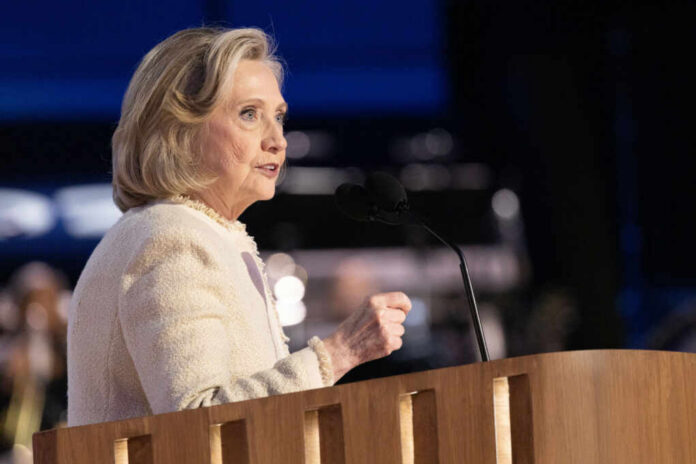
Hillary Clinton is back in the spotlight—this time branding Republicans “politically brain-dead” on family policy, setting off a fresh fight over whether Washington is helping parents or just scoring points.
Story Snapshot
- Clinton used a New York Times op-ed to accuse Vice President JD Vance and national Republicans of obsessing over birthrates while ignoring the cost burdens families face.
- She argued the GOP approach is driven by “nostalgia and misogyny,” claiming it implies women should “know their place” and stay out of the workforce.
- The White House hit back quickly, saying Clinton’s attacks are a “favorite hobby” and pointing to Trump administration moves on fertility drug prices, child tax credits, and school choice.
- The clash lands amid a broader 2026 debate over affordability, parental choice, and whether federal programs or economic growth should be the main tool to support families.
Clinton’s op-ed targets GOP priorities on birthrates and culture
Hillary Clinton published an op-ed on Thursday in The New York Times accusing national Republicans—naming Vice President JD Vance and right-leaning organizations—of focusing on birthrates while failing to address what she described as the financial squeeze on parents. Clinton called the Republican approach “substantively and politically brain-dead,” and framed it as rooted in “nostalgia and misogyny.” Her central claim was that the message amounts to a push toward traditional roles where women did not work and “knew their place.”
Clinton paired her critique with a Democratic policy pitch she described as a “kids agenda.” The policies highlighted in reporting included expanding child tax credits, implementing national paid family leave, investing in early childhood care, protecting children’s health care, and offering guidance for children’s digital lives. Even without full access to the complete op-ed text through the limited research set here, the reported theme is clear: Democrats want to re-center the affordability debate on direct benefits and services, while portraying Republicans as distracted by cultural arguments.
White House response emphasizes tax relief, fertility drugs, and school choice
The Trump White House responded through spokesman Kush Desai in a statement carried by Fox News Digital. Desai characterized Clinton’s criticism as her “favorite hobby” and defended the administration’s record by pointing to actions the White House says support families. Those claims included “slashing” fertility drug prices, expanding child tax credits, and advancing school choice. The exchange reflects a familiar governing split: Democrats argue for new federal entitlements and mandates, while Republicans highlight targeted cost reductions, tax-based support, and choice-driven reforms.
For conservative readers, the practical question is less about Clinton’s rhetoric and more about measurable outcomes: whether policies lower real household costs and increase freedom for parents to choose how to raise their children. Clinton’s framing also keeps the debate in cultural terms—suggesting traditional family arguments are inherently misogynistic—rather than testing which proposals are affordable and effective. That rhetorical strategy can rally partisans, but it can also harden skepticism among voters who are tired of being told their values are unacceptable.
Why “deplorables”-style politics still shapes 2026 debates
Clinton’s op-ed also echoes a pattern from her 2016 campaign, when she described half of Trump supporters as a “basket of deplorables,” using labels such as “racist” and “sexist.” That episode, documented in historical summaries, became a shorthand for elite disdain toward working-class and culturally traditional voters. In this new round, Clinton does not appear to be labeling voters directly, but she is again attaching negative motives—like misogyny—to a Republican policy emphasis associated with Vance and allied groups.
Clinton arguing Republicans ignore affordability while pushing a birthrate-centered narrative, and the Trump administration countering that it is already delivering family-oriented economic relief through specific actions it claims to have taken.
The deeper issue: a shared sense that Washington isn’t delivering
The political significance goes beyond Clinton versus Trump, or Democrats versus Republicans. Both left-leaning and right-leaning Americans increasingly agree that the federal government struggles to solve daily problems efficiently, even when the problems—housing costs, child care costs, wages, health costs—are widely acknowledged. Clinton’s answer leans toward broader federal programs, while the White House highlights reforms and incentives it says reduce costs and expand options. The unresolved question is which approach improves family life without deepening debt, bureaucracy, or dependency.
With Republicans controlling the House and Senate in Trump’s second term, Democrats have limited leverage beyond messaging and procedural obstruction, which makes high-profile attacks like this more politically useful to them. For the GOP, the risk is letting debates get reduced to caricatures—either “misogyny” on one side or “elitist scolding” on the other—while families still struggle with bills. If policymakers want credibility, they will need clearer proof of results: lower costs, higher take-home pay, and policies that respect parents’ choices.
Sources:
Hillary Clinton accuses GOP ‘politically brain-dead’ on family affordability