

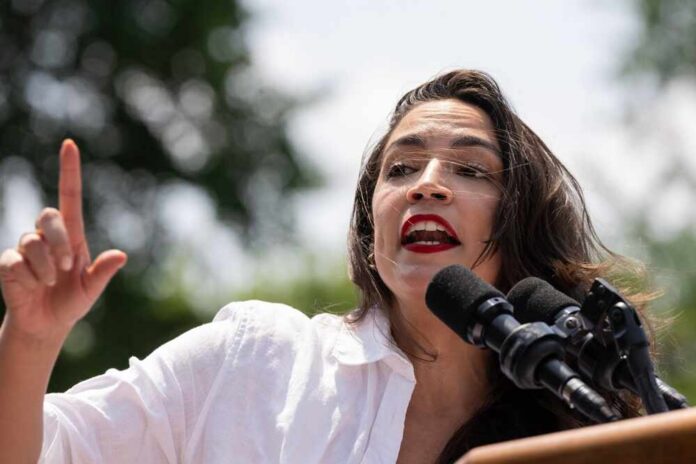
Democrats rattled by the Trump-era map are quietly watching Rep. Alexandria Ocasio-Cortez test-drive a national campaign—without actually announcing one.
Story Snapshot
- AOC has not ruled out a 2028 presidential run, while also leaving open a bid for U.S. Senate in New York.
- Axios reported her team has prepared for both paths, fueled by national travel, organizing, and major fundraising.
- Polling and commentary cited in recent coverage place her among the top-tier Democratic possibilities, with questions about broad appeal.
- A Senate run could trigger a high-stakes intraparty clash with Sen. Chuck Schumer, reshaping Democratic leadership.
AOC Keeps 2028 Options Open While Building Infrastructure
Rep. Alexandria Ocasio-Cortez has publicly responded to 2028 chatter without closing the door on a presidential campaign, while also signaling that any decision depends on support from her constituents and community. The practical point is that the speculation is now backed by activity: interviews addressing the topic, sustained national visibility, and the kind of fundraising and travel that can double as campaign preparation. No formal filing or announcement has been made.
Axios previously described internal planning that treats the next cycle as a strategic crossroads: aim for the White House as the progressive movement’s standard-bearer, or pursue a more traditional statewide leap by running for U.S. Senate. That dual-track approach matters because it suggests discipline and intent, not just social-media buzz. It also puts Democratic power centers on notice, especially if AOC’s ambitions collide with long-serving party leadership in New York.
Why the Senate Option Could Be the Bigger Earthquake
AOC’s potential Senate route draws attention because it could force an immediate reckoning inside the Democratic Party. A statewide run would require broader coalition-building beyond her Bronx and Queens district, while also raising the possibility of a challenge to Sen. Chuck Schumer. That scenario would pit the party’s progressive insurgency against its institutional leadership. Even without a declared candidacy, preparing for that possibility pressures establishment Democrats to defend their record to an increasingly restless base.
Summer 2025 efforts to reach voters outside her core district—such as town halls upstate—fit the profile of a politician widening her footprint. Coverage also highlighted heavy fundraising and large crowds, indicators that her brand travels beyond New York City. For conservatives, this is less about personality and more about policy stakes: AOC is closely associated with the Green New Deal style of governance, a framework many voters blame for higher energy costs and heavier regulation.
What the Early Polling Signals—and What It Doesn’t
Commentary and polling referenced in recent reporting place AOC in the top grouping of hypothetical Democratic primary contenders, including scenarios where she performs competitively in a crowded field. That is significant because it reflects a Democratic Party still searching for a post-2024 direction under unified Republican control in Washington. The strongest verified takeaway is not that AOC is a frontrunner, but that she is positioned to shape the primary agenda. Even a “longshot” presidential bid can move the party’s platform, influence debate topics, and pressure rivals to adopt positions they might otherwise avoid. That matters to older voters across the spectrum who increasingly believe government serves insiders first: populist messaging—left or right—tends to grow when trust in institutions erodes.
How This Fits the Wider 2026 Political Climate
With President Trump in a second term and Republicans controlling Congress, Democrats are incentivized to elevate figures who can energize turnout and fundraising, especially after national losses. AOC’s appeal to younger voters and online activists is widely recognized, and progressive organizations see her as a potential successor to the Sanders-style movement. At the same time, establishment Democrats have signaled concern that her politics can alienate moderates—an argument likely to define the early 2028 fight.
Republicans, for their part, are likely to frame any AOC rise as proof that Democrats are doubling down on the same big-government instincts many Americans associate with inflationary spending, cultural radicalism, and energy restrictions. Democrats will argue their resistance is aimed at protecting vulnerable groups and public investment. The reality is that AOC’s decision—presidency, Senate, or neither—could become a stress test for a party split between institutional caution and activist ambition.
Until AOC makes a formal move, the most responsible conclusion is narrow: credible reporting indicates real preparation, and her own statements keep the door open. For voters frustrated with a system that feels rigged for elites, that combination can be both energizing and destabilizing. The next concrete indicator will be whether her travel, staffing, and fundraising evolve into explicit campaign steps—or remain the kind of political positioning that modern politicians treat as standard operating procedure.
Sources:
AOC’s 2028 Decision: Run for President or Senate
Doug Schoen: Why AOC could take the White House in 2028 — and Kamala Harris won’t
Should Alexandria Ocasio-Cortez Run for President?