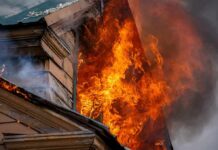
When a routine fire call at a Staten Island shipyard turned into a deadly mass‑casualty blast, New Yorkers got another harsh reminder that government only seems to ask hard questions about safety after people are already dead or in the hospital.
Story Snapshot
- One civilian was killed and more than 30 people, mostly first responders, were injured after a fire and explosion at a Richmond Terrace shipyard on Staten Island.[4]
- Firefighters initially responded to a barge or dry‑dock fire; an explosion followed while crews were fighting the blaze, injuring dozens on scene.[3][4]
- Officials have confirmed the fire is under control and all victims accounted for, but they still do not know what caused the blast.[2][4]
- The incident exposes a familiar gap: dramatic coverage of casualties arrives instantly, while real answers about industrial safety and government oversight may take months.[1][4]
What We Know About the Staten Island Shipyard Disaster
New York City Fire Department officials say the crisis began Friday afternoon when a fire broke out at a shipyard along Richmond Terrace on Staten Island’s north shore.[3] Responders arrived to find a barge or dry‑dock area burning in what quickly became a large industrial incident.[3][4] While firefighters were attacking the blaze, an explosion ripped through the site, turning a difficult fire into a mass‑casualty event that drew roughly seventy fire and emergency medical units and more than two hundred first responders.[4]
Initial live reports spoke of at least sixteen injuries, including multiple firefighters and a civilian, with several listed as serious.[1][3] As the response unfolded and hospitals updated counts, officials later confirmed that the number of victims climbed to thirty or more.[4] By the evening briefing, city leaders reported that thirty‑six people had been treated as patients: two civilians and thirty‑four members of the fire department, including emergency medical personnel.[4] One civilian died at the scene or shortly afterward, while others were transported to area hospitals.[2][4]
Who Was Hurt, and How Serious Are the Injuries?
Fire department breakdowns show that this was not just a tragedy for civilians but a brutal hit on front‑line responders.[3][4] Earlier counts described two firefighters and one civilian with serious injuries, two additional firefighters with moderate injuries, and a larger group of firefighters and emergency medical workers with minor injuries.[3] Later, hospital officials briefed reporters that a fire marshal suffered a skull fracture and brain bleed from blast pressure, and another firefighter experienced serious but improving blast‑related trauma, both classic dangers in confined industrial spaces.[4]
City leaders emphasized that most injured firefighters and emergency medical workers are expected to recover, but they described the fire marshal’s condition as critical yet stable.[4] Doctors explained that although there was no penetrating shrapnel, the invisible force of the blast wave caused internal head trauma that will require close monitoring for swelling.[4] Those details underline how quickly an industrial site can turn deadly even for highly trained crews, and why responders view shipyard fires and explosions as among the most unforgiving emergencies they face.[3][4]
Unanswered Questions About Cause and Accountability
Despite the scale of the event, officials have been straightforward about one key fact: they still do not know what triggered the explosion.[1][2][4] Firefighters first confronted what sounded like a standard industrial blaze in a shipyard structure or barge, but a later blast during operations suggests something unstable or inadequately contained on site.[2][3][4] City leaders say fire marshals will carry out a comprehensive cause‑and‑origin investigation once the scene is fully safe, and that their findings will be shared publicly when complete.[4]
That timeline will sound familiar to Americans across the political spectrum who have watched other industrial disasters play out the same way: intense early coverage of smoke, sirens, and casualty counts, followed by months of bureaucratic quiet.[1][4] At this stage there is no public evidence proving negligence, code violations, or a specific safety failure at the Staten Island shipyard.[1][2][4] There is also no public documentation showing that every required safety measure and inspection was firmly in place.[1][2][3][4] The truth will hang on records that ordinary citizens will not see quickly: fire marshal files, workplace‑safety inspections, permits, and worker testimony.
Why This Incident Taps Into a Deeper Distrust of the System
For many Americans, the details of this explosion plug straight into a larger frustration that spans party lines: serious hazards often surface only after something blows up.[1][4] Conservatives see another example of regulators who bury people in red tape but cannot keep workers and first responders safe at a basic industrial site. Liberals see blue‑collar employees and public servants again absorbing the risk while those who profit from dangerous operations can hire lawyers to manage the fallout.[1][4]
A devastating explosion at a shipyard dry dock in Staten Island, New York, has left one civilian dead and 36 others injured. The tragic incident unfolded at a Richmond Terrace facility as FDNY firefighters were actively responding to a basement fire and attempting to rescue two…
— News18 (@CNNnews18) May 23, 2026
Both sides also recognize how the information system favors spectacle over accountability. Video clips of the blast and heroism of firefighters spread across social platforms within minutes, while the painstaking investigation into what went wrong may be buried in government archives or released long after the public has moved on.[1][4] In a country where many already believe that powerful interests and entrenched bureaucracies protect each other first, the Staten Island shipyard disaster will deepen the demand for something basic: timely, transparent answers about how an ordinary workday turned into another avoidable funeral.
Sources:
[1] YouTube – BREAKING: Explosion on New York’s Staten Island injures 16
[2] YouTube – Firefighters Among 16 Injured at Shipyard Explosion
[3] YouTube – 16 injured in explosion, fire at Staten Island shipyard
[4] Web – A fire and shipyard explosion on Staten Island injures 30 people …