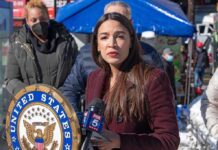
Alexandria Ocasio-Cortez’s decision to pass on Francesca Hong is a sharp sign that even prominent socialists are picking their battles.
Quick Take
- Representative Alexandria Ocasio-Cortez declined to endorse Francesca Hong in the Wisconsin governor’s race.
- Ocasio-Cortez said her main focus is winning back the House and helping Senate races.
- Reporting says the move matches Bernie Sanders and the national Democratic Socialists of America, which also have not backed Hong.
- Hong still has some progressive support, but key national names have stayed away.
Ocasio-Cortez Draws a Clear Line
Representative Alexandria Ocasio-Cortez said she has not endorsed Francesca Hong and instead wants to focus on congressional races. On ABC News’ “This Week,” Ocasio-Cortez said her goal is to help Democrats win back the House and improve their chances in the Senate. That puts Hong, a Wisconsin gubernatorial candidate and democratic socialist, outside the circle of top national backing she might have expected from a leading progressive voice.
The move matters because endorsements are a form of political signal. When a star lawmaker with national reach stays out of a race, the absence itself can shape how activists, donors, and local voters read the field. In this case, The Hill reported that Ocasio-Cortez’s choice lines up with Senator Bernie Sanders and the national Democratic Socialists of America, both of which have also declined to endorse Hong.
A Broader Split Inside the Progressive Wing
Hong has still attracted some support from national progressives, but not the movement’s two best-known democratic socialist figures. Reporting from the Milwaukee Journal Sentinel said Sanders does not plan to endorse Hong and that Ocasio-Cortez has not backed her either. American Bazaar also reported that Ocasio-Cortez and Sanders had backed Abdul El-Sayed in Michigan instead of Hong in Wisconsin. That leaves Hong with visible allies, but without the most famous stamp of approval.
The pattern shows how progressives often split between ideology and strategy. A candidate can share a movement’s label and still fail to win its highest-profile endorsements if those leaders think another race matters more. Ocasio-Cortez made that calculation explicit by saying her attention is on the House and Senate map. For voters watching national politics, the message is simple: shared ideology does not always lead to shared support.
Why the Silence Matters in Wisconsin
Hong’s race has drawn notice because she is part of a larger fight over the future of the Democratic Party. Even without Ocasio-Cortez’s backing, she remains a serious figure in the Wisconsin contest, and other progressives have rallied to her side. But the refusal from two of the movement’s biggest names weakens the idea that the left speaks with one voice, especially when state races collide with national strategy.
"Squad" Rep. ALEXANDRIA OCASIO-CORTEZ defended Wisconsin gubernatorial candidate Rep. FRANCESCA HONG's previous statements calling to defund the police, however, she refrained an endorsement in the race – Hong is a DSA candidate with a massive double-digit lead in the race
— charles s. benjamin (@CBenjmin) August 10, 2026
That tension also reflects a familiar problem in modern politics. National figures want influence, but endorsements carry risk when a candidate becomes controversial or when the movement itself is divided. Ocasio-Cortez did not attack Hong in her comments; she simply put other races first. In a year shaped by hard choices and tight alliances, that kind of non-endorsement can be as revealing as a full endorsement.
Sources:
townhall.com, thehill.com, americanbazaaronline.com