
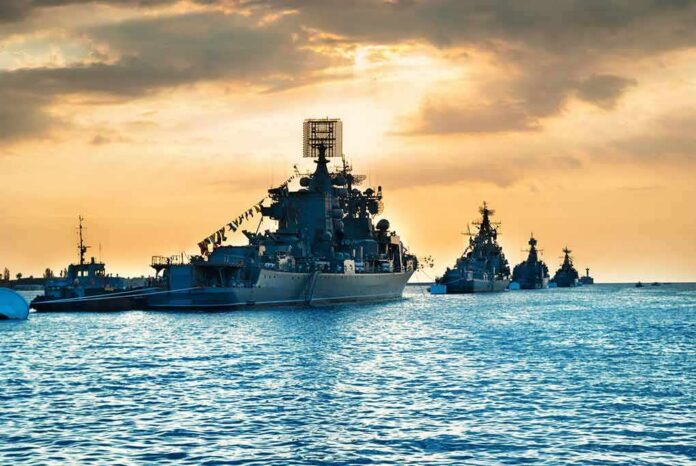
One tanker was disabled after repeated warnings in the Strait of Hormuz, and the move shows how fast this waterway can turn into a military flashpoint.
Quick Take
- U.S. military reporting says the tanker kept moving toward Iran despite repeated warnings.
- The latest action fits a wider U.S. enforcement campaign around Iranian ports and shipping routes.
- Public reports describe the blockade in different ways, which adds confusion about its exact scope.
- Critics say the public record still lacks the full ship logs and legal papers needed to test the case.
What Happened in the Strait
U.S. military personnel disabled a tanker on July 25 after officials said the crew ignored repeated warnings and kept trying to move through the Strait of Hormuz. The New York Post reported that the vessel was halted while trying to breach a regional blockade, and that it was one of several ships officials say have been turned back under the same enforcement effort.
That detail matters because the Strait of Hormuz is not a side channel. It is one of the world’s most important shipping routes. When a tanker is stopped there, the impact reaches oil markets, insurers, shippers, and nearby states at once. The record supplied here says U.S. forces have also redirected or disabled other ships during this blockade campaign.
How the Blockade Is Being Framed
The strongest public U.S. position is simple: vessels traveling to or from Iranian ports are being stopped, while ships bound elsewhere should still move through the region. Reuters reported that the military said the blockade applies to traffic to and from Iran, and NPR said U.S. Central Command planned to intercept such vessels while leaving other Persian Gulf traffic free to pass.
That framing is important because legal and practical questions do not always match. Reuters also reported that humanitarian shipments would be exempt, which shows the policy was not described as a blanket shutdown of all maritime movement. Still, the available reporting here does not include the tanker’s deck logs, bridge audio, or the full after-action report for this specific incident.
Why the Case Still Draws Doubt
Critics in the material supplied here focus less on the warning sequence and more on legality and proof. BBC reporting cited the International Maritime Organization as saying no nation has legal authority to block shipping in straits used for international transit, and the supplied record does not show a court ruling that settles the issue for this tanker.
7 PM Top-of-the-Hour News
Rising tensions in the Strait of Hormuz today as an oil tanker exploded as it hit a mine – that, according to Iran’s military-linked state media. The report went on to claim the Islamic Republic had intercepted at least six ships in the past 24 hours.… pic.twitter.com/eUxlGgRYAP
— Worldwide News Network (@WorldwideNNX) July 26, 2026
That gap matters in a country where trust in institutions is already thin. Supporters of the operation see a state defending a restricted zone against a hostile route toward Iran. Skeptics see official power outrunning public proof. Both views grow stronger when military agencies control most of the records and reporters are left with partial statements and short clips instead of full documentation.
What the Broader Pattern Shows
The story also fits a larger pattern of maritime conflict in the Gulf. Earlier reports described ships being turned around, redirected, or disabled as the blockade took hold, and later reporting said multiple vessels had been stopped or forced to reverse course. That pattern suggests this was not an isolated event, but part of a sustained effort to police access to Iranian ports.
For readers, the larger lesson is not just about one tanker. It is about how modern crises are reported before the facts are fully settled. A military can release a short statement, news outlets can repeat it fast, and the public can be left without the records needed to judge what really happened. In a tense region like Hormuz, that information gap can shape opinion as much as the incident itself.
Sources:
nypost.com, aljazeera.com, reuters.com, npr.org, washingtonpost.com, axios.com, apnews.com, wsj.com, nytimes.com, militarytimes.com, youtube.com, navytimes.com