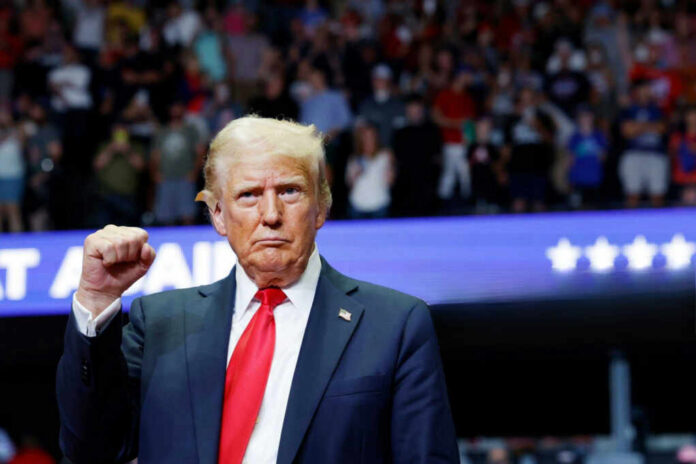
President Trump is heading to China with a hand-picked team of America’s biggest CEOs—an aggressive bet that deal-making can outmaneuver the CCP while Democrats at home keep trying to tie his hands.
Quick Take
- Trump will meet Xi Jinping in China on May 14, 2026, for a two-day summit that blends geopolitics with business negotiations.
- The White House says 16 top U.S. CEOs—including Elon Musk (Tesla) and Tim Cook (Apple)—are traveling with the president.
- Agenda items reported by major outlets include the Iran war, trade disputes, Taiwan tensions, and potential business deals.
- The administration is highlighting plans to form U.S.-China “boards” focused on investment and trade, signaling a push for structured negotiations.
What Trump’s China Trip Signals in 2026
The White House says President Donald Trump will travel to China on Thursday, May 14, 2026, for a high-stakes summit with Chinese President Xi Jinping. The trip stands out because Trump is not traveling alone: the White House distributed a list of 16 U.S. CEOs expected to attend, spanning major sectors of the American economy. The stated focus combines national-security flashpoints with economic bargaining, a familiar Trump approach.
Reported agenda topics include the Iran war, trade, and Taiwan, alongside potential business agreements. That blend matters because it treats economic leverage as part of statecraft, not a separate track. Supporters see a practical attempt to protect U.S. interests using American commercial power. Critics worry that any engagement risks giving Beijing propaganda value or weakening U.S. resolve, especially when corporate incentives don’t always match national priorities.
Why the CEO Entourage Matters—and Why It’s Controversial
Trump’s decision to bring corporate leaders puts the interests of U.S. producers, investors, and supply chains directly into the room. The CEO list includes Musk and Cook—leaders whose companies have significant exposure to China through manufacturing, sales, or both. The administration has also described the trip as a chance to establish a U.S.-China board of investment and a board of trade, implying a more formal channel for negotiations beyond one-off summits.
The political risk is obvious in a country already skeptical that elites are playing by different rules. Many conservatives remember years of globalist assumptions that shipped manufacturing abroad and left working communities behind. Many liberals, meanwhile, argue big business gets privileged access while ordinary families face high costs and unequal opportunity. That shared frustration is why transparency matters: Americans will want to know whether proposed “boards” protect U.S. workers and technology, or merely create another layer of insider deal-flow.
Trade, Tech, and the Limits of “Selective Engagement”
The reported trip comes after years of economic friction and tech restrictions, with the U.S. tightening controls around strategic industries. At the same time, major U.S. companies remain connected to Chinese markets and manufacturing capacity, creating pressure for stability even when relations are tense. That reality helps explain why a president running an America First agenda might still pursue “selective engagement” aimed at extracting concessions while keeping leverage like tariffs on the table.
One uncertainty involves who is not going and what that implies. Reports indicate some notable absences and at least one apparent change in attendance, reflecting how fluid and sensitive these arrangements can be. Americans should treat early “who’s-in, who’s-out” chatter cautiously until final rosters are confirmed during travel. What is clear is the administration wants the trip framed as a U.S.-interest negotiation, not a goodwill tour—and it will be judged by concrete outcomes.
Iran, Oil Prices, and What Voters Will Watch Next
The inclusion of the Iran war on the discussion agenda highlights why this summit is about more than tariffs. If China can influence Tehran or help de-escalate pressures that ripple through global energy markets, the impact would reach U.S. households quickly through fuel and inflation-sensitive prices. With voters still wary of fiscal mismanagement and cost-of-living spikes, any credible path to easing energy volatility is politically meaningful, even if diplomacy with Beijing remains unpopular.
JUST IN: @POTUS BRINGING HEADS OF INDUSTRY LIKE MUSK TO CHINA
"Looks like @POTUS is bringing…Elon Musk, Tim Cook, Blackrock, Blackstone…so many others. On this trip…meet the head of CCP. What do you think Pres. Trump's plan is?" @JackPosobiec @SamuelBrownback pic.twitter.com/7h7XqBkx4z
— Real America's Voice (RAV) (@RealAmVoice) May 11, 2026
The larger test is whether Washington can negotiate without sliding back into the old pattern where well-connected insiders win and everyone else gets excuses. Democrats are likely to attack Trump for engaging China, while many Republicans will demand proof that the administration protected U.S. intellectual property, supply-chain security, and American workers. Until detailed agreements are public, the fairest conclusion is also the simplest: this is a high-leverage play with high stakes, and Americans should demand measurable results.