
Glaciers on Central Asia’s “roof of the world” are suddenly melting after decades of resilience, raising serious questions about how global climate narratives are being sold to the public and what that means for future water and food security.
Story Snapshot
- Field teams in Tajikistan report rapid ice loss and vanishing high-altitude snow on key Pamir glaciers.
- New research shows declining snowfall, not just warmer air, is now undermining one of the world’s most resilient glacier regions.
- International agencies blame broad “climate change,” often glossing over complex local drivers and data gaps.
- Faster melt threatens Central Asia’s rivers and farming, increasing regional instability that can draw in global powers.
Pamir glaciers: from stability to sudden warning signs
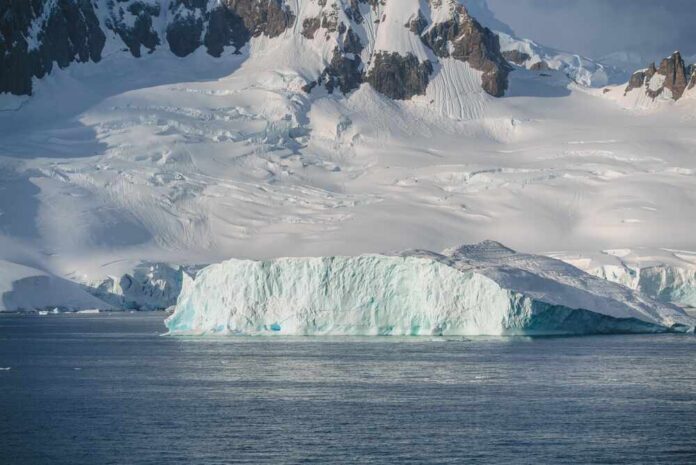
Tajik scientists conducting rare winter fieldwork on a high Pamir glacier recently reported a “critical” situation, with ice thickness dropping by more than one meter in just a single season at nearly 5,000 meters elevation.[1][6] Measurements from snow pits between about 4,790 and 5,012 meters showed accelerated melting even in zones once considered safely cold and stable.[1] Researchers also observed that in the past five years, seasonal snow cover in the accumulation zone above roughly 5,100 meters has almost disappeared, meaning the glacier is no longer being properly replenished each winter.[1][6]
Scientists warn that when a glacier’s accumulation zone loses its long-lasting snow, the system shifts from slow, steady storage to net loss, turning a natural “water tower” into a shrinking reservoir.[1] The Pamir region supplies much of Central Asia’s major rivers, so this new pattern alarms hydrologists who track year-round flow for farming and drinking water.[1][5] The United Nations and regional experts now link this rapid melt to potential threats for billions who depend, directly or indirectly, on glacier-fed rivers for agriculture and daily life.[1][4][5]
Climate change, natural cycles, and the role of snowfall
Many global organizations point to human-driven climate change as the central driver of glacier loss, emphasizing that glaciers worldwide are shrinking faster now than in pre-industrial times.[2] Tajik meteorological records show average annual temperatures have risen both in valleys and in high mountain zones over the past 70 to 80 years, narrowing the margin for ice survival, and contributing to a roughly 30 percent reduction in national glacier area since about 1930.[2] However, experts in the region also stress that glacier melt is a natural process that has occurred for centuries and cannot be fully “stopped,” only influenced at the margins.[2]
A new peer-reviewed study of the Northwestern Pamirs offers a more detailed picture, arguing that recent damage to glacier “health” since about 2018 has been driven primarily by a steep drop in snowfall and total precipitation, not just rising air temperatures.[4][5] Researchers installed a monitoring network on a benchmark glacier in central Tajikistan, then modeled climate, snowpack, glacier mass balance, and water flows from 1999 to 2023.[4] The study found that an approximately 328 millimeter decline in total precipitation translated into much less fresh snow, weakening the glacier’s ability to rebuild lost mass each winter.[4][5] In response, glacier melt increased to offset a portion of the lost snowfall, temporarily propping up river flow even as the ice reserve shrinks.[4]
Water security, regional stability, and global agendas
Because the Pamir glaciers feed rivers that cross borders into downstream countries, continued melting poses serious long-term risks for Central Asia’s food and water security.[4][5] As long as extra meltwater flows, farmers may see short-term benefits in irrigation, masking the danger that the underlying “ice savings account” is being drained.[4] Analysts warn that once the ice mass declines past a critical point, river flows can fall sharply, putting pressure on rural communities, power generation, and cross-border water sharing agreements.[4] International agencies describe these glaciers as key “water towers” whose loss could destabilize already fragile regions.[4][6]
Documentaries featuring Pamiri communities highlight how local women and families are already adapting to changing water availability, reporting that glaciers in the Pamirs are melting at rates comparable to massive ice in Greenland and that stream levels have become less predictable for traditional farming.[5] Central Asian and international institutions, including nuclear and energy watchdogs, have launched programs to monitor glaciers and protect water resources, noting that temperatures in the broader region are rising roughly twice as fast as the global average.[6] For Americans watching from afar, these developments show how complex climate, water, and security issues in distant mountain ranges can become leverage for large international bureaucracies that rarely emphasize local variability or natural drivers like snowfall shifts.
Science, uncertainty, and what policymakers rarely admit
Glaciologists worldwide routinely caution that glacier retreat can result from multiple causes, including melt, evaporation, wind scouring, and changes in snowfall, and that the relative importance of each driver differs by location. Studies from other high mountain regions show that temperature increases are important, but local factors such as precipitation patterns, debris cover, surrounding topography, and the formation of glacier lakes also shape how quickly ice disappears. Because high-altitude observation networks are sparse, experts often have to rely on a combination of limited fieldwork, satellite data, and modeling to estimate mass loss and attribution, leaving room for debate over what factor dominates at any specific site.[3]
Until recently, the Pamir mountains in central Asia have bucked the global melting trend, but in 2025, the region’s glaciers experienced a massive loss of ice due to extreme heat https://t.co/xln5hne8rL
— New Scientist (@newscientist) May 29, 2026
For citizens and voters, the Pamir story underscores the importance of demanding clear, specific data when unelected global bodies call for sweeping economic or energy sacrifices in the name of “saving the glaciers.” The evidence from Tajikistan shows that both warming and reduced snowfall matter, that some glaciers had remained relatively stable until recently, and that sudden tipping points can occur when precipitation patterns change.[2][4][5] Sound policy requires honest recognition of this complexity, not generic slogans that lump every glacier on earth into a single, simplified narrative.
Sources:
[1] Web – Glaciers in the ‘roof of the world’ have suddenly started melting
[2] Web – Pamir Glaciers Rapidly Melting Even Above 5,000 Meters, Tajik …
[3] Web – Why are Tajikistan’s glaciers melting and how dangerous is it for us?
[4] Web – Pamiri women and the melting glaciers of Tajikistan
[5] Web – Melting Glaciers Threaten Central Asia’s Food and Water Security
[6] Web – Snowfall decrease in recent years undermines glacier health … – PMC