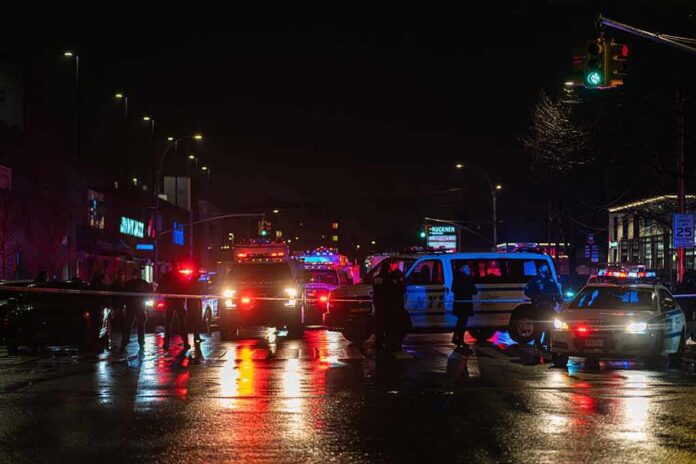
A deadly rear-end train collision near Bedford has once again exposed how ordinary passengers pay the price when big systems fail and politicians race to spin the story.
Story Snapshot
- Two southbound commuter trains crashed near Bedford, killing the driver and injuring about 89 people.
- Passengers describe a “bomb explosion” impact, bloodied faces, and broken limbs as carriages buckled.
- Police declared a major incident while investigators still cannot explain how two trains ended up on the same line.
- The disaster highlights how complex systems fail when safety, maintenance, and honest oversight slip down the priority list.
Deadly Rush-Hour Crash On A Busy Main Line
Late Friday afternoon, two East Midlands Railway trains heading toward London St Pancras collided just south of Bedford, turning a normal commute into a scene of horror.[2] Both services were packed with workers and families when one train slammed into the back of another at about 5:15 p.m., at the height of rush hour.[4] British Transport Police quickly declared a major incident, and emergency crews flooded the area with helicopters, fire engines, and ambulances.[2] For many on board, it was the worst moment of their lives.
Officials say the driver of the rear train died at the scene, while the East of England Ambulance Service reported 89 people injured in total.[4] Medics on site later broke that down to 11 passengers with very serious injuries, 22 with serious injuries, and 56 with minor wounds ranging from cuts to broken bones.[2] Some victims were treated on the tracks; others were moved by stretcher to nearby hospitals. Police later said more than 80 people needed hospital care, with at least nine in critical condition the next morning.[5]
Passengers Describe “Bomb-Like” Impact And Chaos
Passengers on board say the impact came with no warning: one moment they were scrolling phones and chatting, and the next they were thrown across the carriage as seats buckled and luggage flew.[3] One survivor said it “felt like a bomb explosion,” with a blast of force followed by darkness, screams, and the smell of smoke and brake dust.[3] Video from the scene shows stunned riders with blood on their faces stepping down onto the ballast, clutching injured arms and legs while trying to call loved ones.[4]
A passenger named Dr. Pete Knapp, who was traveling home, said the crash hit at about 5:12 p.m. and left him with leg and back injuries after he was hurled forward inside the coach.[2] He described people pinned by twisted seats and others struggling to stand because of suspected broken legs.[2] Many passengers had to walk along the tracks to reach buses that took them onward, a frightening trek past mangled metal that drove home how close they had come to death. For ordinary people just trying to get home from work, the trauma will not fade quickly.
Major Incident Declared, But Key Questions Still Unanswered
British Transport Police, Bedfordshire Police, and local fire and ambulance services mounted a large joint response, closing the busy north–south main line and turning the area into a sealed-off disaster zone.[2] The Rail Accident Investigation Branch and other safety teams arrived to collect black box data, signal logs, and driver records to understand how a rear-end collision could happen on a modern, signaled route into a major capital city.[5] Investigators say they are still piecing together the chain of events and have not yet named a cause.
🚨 BREAKING: “It felt like I had been in a bomb explosion.”
An eyewitness to the Bedford–Luton train crash described scenes of devastation after the collision.
Content Warning: Graphic
Passengers reported multiple injuries as emergency teams, air ambulances, and specialist… pic.twitter.com/VtldrGrhGq
— Brics Times (@Brics_Timesx) June 19, 2026
Rail safety experts note that fatal train collisions are now rare in Britain and Europe, thanks to decades of investment in signaling and crash protection.[21] Studies show fatal train collisions and derailments per train-kilometer have fallen by more than 70 percent since 1990, making rail travel far safer than it once was.[21] Yet the Bedford crash proves that when complex systems fail—whether from signaling errors, human mistakes, or maintenance gaps—the results still strike ordinary families first, not the bureaucrats and executives who design and oversee these systems.[19]
Accountability, Transparency, And Lessons For America
As British investigators dig into what went wrong near Bedford, they will likely review signal states, braking data, and dispatch decisions, just as past inquiries did after deadly crashes like Southall in 1997, where missed red signals and late braking killed seven and injured more than 130.[6] That earlier disaster led to new safety systems and rules, proving that clear facts and hard questions can drive life-saving changes when government chooses transparency over spin. The Bedford victims deserve the same level of honesty and follow-through today.
For American readers, this foreign crash is still a warning at home. Our own rail network is aging, and our leaders often talk more about flashy climate branding than about nuts-and-bolts safety, maintenance, and enforcement. When government loses focus, it is not lobbyists or agency bosses who get hurt—it is working families on their way home from a long day. Real public safety means reliable infrastructure, clear accountability when systems fail, and respect for the people who trust those systems with their lives every day.
Sources:
[2] Web – Bedford train crash latest: Nine people in critical condition after …
[3] Web – Bedford Train Accident: Lot Of People Had Broken Legs – NDTV
[4] Web – Two Passenger Trains in Deadly Collision in Britain – ny times
[5] YouTube – ‘A number of people injured’ in train collision near Bedford
[6] Web – Emergency services respond to a deadly train collision near Bedford …
[19] Web – Mind the gap: 11 years of train-related injuries at the Royal London …
[21] Web – How common are train crashes in Wales? – BBC