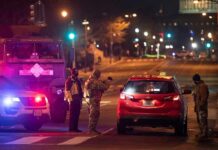
When one country can hurl 70 missiles and 611 drones in a single night, it raises hard questions about who is really running the world and how safe any nation’s people really are.
Story Snapshot
- Russia reportedly launched 70 missiles and 611 drones at Ukraine overnight, one of the war’s largest air attacks.
- Ukrainian air defenses say they downed most of the weapons, but some still hit homes, power systems, and a historic monastery.[1][6]
- The strike shows how cheap drones and advanced missiles can overwhelm even Western-supplied defenses, with lessons for the United States and NATO.[4]
- Information about exact numbers and deaths is still shifting, highlighting how hard it is to know the full truth during modern wars.[1][7]
What Happened In The Overnight Barrage
Ukrainian authorities say Russia carried out one of its biggest combined air attacks of the war, firing about 70 missiles and 611 drones across the country in a single night.[1][3] Ukraine’s air force says its defenses shot down 50 missiles and 582 drones, but dozens of weapons still got through and hit targets in several regions.[1] Officials report strikes on Kyiv, Kharkiv, Dnipro, Sumy, and other areas, with at least nine people killed and many more injured in the first counts.[1]
Reports and videos from the ground show high-rise homes on fire in Kyiv, burned-out cars, and emergency crews pulling survivors from rubble.[6] A major spiritual site, the Kyiv Pechersk Lavra monastery, caught fire after nearby impacts, shocking many Ukrainians who see it as a symbol of their history and faith.[1] Ukraine’s military says that even with many interceptions, 47 aerial weapons still struck 42 locations, including homes, energy facilities, and other important sites.[1]
How The Attack Was Carried Out And What It Means Militarily
Ukrainian and international reports say Russia used a mix of ballistic missiles, cruise missiles, and several types of attack drones to stretch air defenses to the limit.[3] One breakdown from Ukrainian sources lists hypersonic Zircon anti-ship missiles, Iskander and S-400 ballistic missiles, and Kh-101 cruise missiles among the 70 missiles used. A separate analysis notes that Ukrainian systems “intercepted or suppressed” most of the incoming weapons, but even a small number that slip through can cause major damage and terror.
Military analysts point out that cheap drones, launched in the hundreds, can force defenders to fire many costly interceptor missiles, draining stockpiles and budgets.[4] Hypersonic weapons such as the Zircon, which may fly at many times the speed of sound, are even harder to stop, and video commentary claims two or three may have punched through defenses around Kyiv.[4] The attack underscores a trend that worries many Americans and Europeans: even advanced systems like the United States Patriot batteries can be overloaded or outmatched by sheer volume and speed.[4]
Fog Of War: Numbers, Narratives, And Trust
Most of the numbers now in headlines come from Ukrainian military statements repeated by media and social posts, not from open raw data or neutral observers.[2][5] Ukraine describes the interception figures as based on early assessments, which often change after radar logs and debris are reviewed more carefully.[7] Some outlets say at least four people died, while others report nine deaths or more, and local officials in different cities have released different injury counts, showing that the picture is still incomplete.[6][1]
There is also little public evidence yet from Russian military sources about how many weapons were fired or which targets they meant to hit.[8] Russia has often claimed it aims at military or industrial sites, while Ukraine and many Western outlets highlight images of housing blocks and historic churches in flames.[6][1] This clash of narratives feeds a deeper problem that Americans on both left and right know well: during war, governments and big media often give only the parts of the story that serve their side, leaving citizens to sort truth from spin on their own.
Why Americans Across The Spectrum Should Care
For many conservatives, this strike highlights national security worries and the limits of globalist promises.[3] Washington has spent hundreds of billions of dollars on foreign wars and foreign aid over the last decades, yet even cutting-edge systems cannot fully protect a friendly capital from swarms of cheap drones and advanced missiles.[4] That raises a hard question: if the United States struggles to secure its own border and cities now, how ready is it for a world where hostile powers can send similar attacks much farther and faster?
"That's the crucial difference – Ukraine is attacking strategic military targets, while Russia is severely damaging a Ukrainian UNESCO World Heritage Site with a drone strike.
And another thing: It's completely irrelevant whether the Kyiv Pechersk Lavra was severely damaged by…
— Arndt Lange (@arndt_m_lange) June 16, 2026
For many liberals, the attack underscores the human cost of great-power games and the growing gap between ordinary people and elites.[6] While global leaders trade statements and defense contractors profit from new weapons, families in Kyiv, like families in American cities, watch homes burn and loved ones die, yet feel they have no real say in the choices that led there.[6] Both sides in the United States can see a pattern: powerful states using high-tech force, controlled by political and corporate elites who rarely pay the price that regular people do.
Sources:
[1] Web – Russia launched 70 missiles, 611 drones at Ukraine overnight: …
[2] X – Taras Kachka
[3] Web – The Ukrainian military says Russia has launched 70 missiles and …
[4] Web – The Ukrainian military says Russia has launched 70 missiles and …
[5] Web – Russia launched one of its largest aerial attacks on Ukraine …
[6] YouTube – Hours After Trump-Zelensky Call, Russia Hammers Kyiv In Massive …
[7] Web – Orthodox leader calls Putin ‘Antichrist’ after airstrike on historic …
[8] Web – Russia strikes leave historic Kyiv cathedral in flames – DW