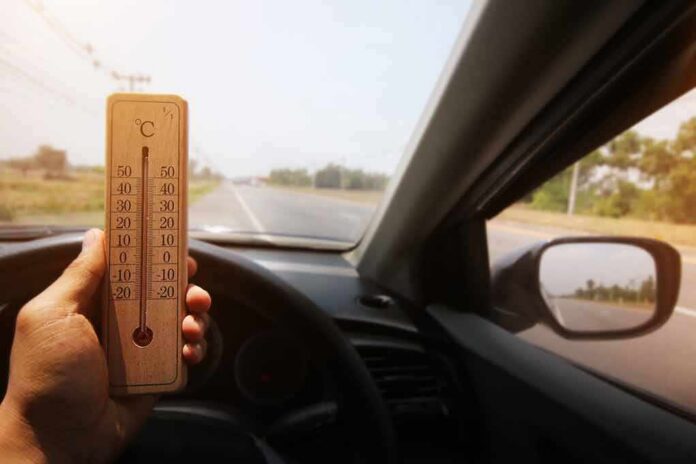
When France’s meteorological service declared July its hottest month on record, it crystallized a season in which extreme heat stopped being an anomaly and became the country’s new climatic baseline.
Key Points
- Météo-France’s national data show July 2026 as the hottest July observed in France since systematic records began just after World War II, overtaking previous benchmarks from 2003 and 2006.
- The record did not hinge on a single scorcher but on a prolonged 16‑day heatwave, exceptionally hot nights, and a sustained elevation of temperatures across much of the country.
- France now relies on a national thermal indicator—an average of day and night temperatures from multiple stations—to track not just extreme days but the “background” heat that drives health and infrastructure impacts.
- Confusion between “hottest day,” “longest heatwave,” and “hottest month” is common in public debate; understanding the metrics is essential to making sense of record‑breaking summers and their link to climate change.
How France Measures a “Hottest Month”
When meteorologists call a month “the hottest on record,” they are not reacting to a headline‑grabbing afternoon peak; they are ranking the entire month’s average temperature against a historical archive. In France, Météo-France does this using a national thermal indicator, a composite measure that averages day and night temperatures from a set of benchmark stations distributed across the country. This indicator smooths out local spikes and cool pockets, yielding a single number that represents how warm France, as a whole, felt over a given period.
For climate statistics, that daily indicator is then aggregated to create monthly means and anomalies—differences from a reference climatology, typically the 1991–2020 average. A month becomes “hottest on record” when its national mean temperature exceeds all previous values in the archive, which in France extends back to the mid‑20th century for robust nationwide coverage. That is the basis on which Météo-France identified June 2026 as the hottest June ever recorded, with a national average of 22.7°C, about 3.8°C above the 1991–2020 norm. The July record follows the same logic.
July 2026: From Long Heatwave to Record Month
The defining feature of France’s record July was persistence. According to contemporaneous summaries of Météo-France’s analysis, the country underwent its second major heatwave of the summer from July 4 to July 19—a 16‑day episode that ranks among the longest such events documented by the national service. During this period, the national thermal indicator remained elevated day and night, passing the heatwave threshold and staying there for more than two weeks.
Within that episode, July 12 emerged as the hottest day nationally, with the 24‑hour thermal indicator reaching 28.1°C. What makes that figure significant is not that it surpassed the spectacular 30°C national averages seen on June 24–25, which set France’s all‑time daily record; rather, it shows that July’s heatwave maintained a level of “background” warmth high enough, for long enough, to push the entire month’s mean into record territory. In plain terms, June delivered France’s hottest days, but July delivered an extraordinary stretch of hot days and very warm nights that accumulated into the hottest July on record.
Confirming the July Record: What the Evidence Shows
The strongest direct indication that July 2026 set a national July record comes from a specialized meteorological outlet, La Chaîne Météo, which reported that Météo-France’s data confirmed “the hottest July observed in France since 1945,” with a national thermal anomaly of about +3.8°C relative to the late‑20th‑century climate. This framing mirrors, in both wording and magnitude, Météo-France’s own public description of June 2026 as the hottest June ever recorded. Taken together, these sources show the national service was explicitly ranking months and publishing anomaly values that summer.
While the corpus available publicly does not reproduce the exact sentence from Météo-France’s July climate bulletin, it does include official material on the heatwave itself. An agency update on the July event emphasizes “exceptionally warm nights” and lists numerous station records and near‑records: nighttime minima around 27°C at Nîmes and 26.6°C at Avignon, and daytime maxima of 42.1°C at Saintes and 41.2°C at Narbonne, among others. These details are consistent with a month in which a large share of the country spent long periods under oppressive heat, particularly at night—precisely the pattern that drives monthly means upward.
There is no competing dataset or named counter‑statement challenging the record‑month conclusion; the main limitation is simply that most of what the public sees are secondary summaries rather than the full climatological bulletin. In the current evidence, June’s record is documented more explicitly than July’s, but the July claim is supported by coherent, mutually reinforcing sources and sits squarely within the well‑established methodology Météo-France uses for monthly rankings.
Metrics That Shape Public Understanding—And Confusion
Part of the difficulty in communicating records lies in the proliferation of overlapping metrics. In France’s 2026 summer, the public heard about at least four distinct but related records: the country’s hottest individual day, its hottest June, one of its longest heatwaves, and its hottest July. Each rests on a different calculation. The all‑time daily record refers to a 24‑hour national thermal indicator peaking at around 30°C on June 24, beating previous highs from August 2003 and July 2019. The month records rely on 30‑day averages, while heatwave rankings combine duration, spatial extent, and intensity.
Media coverage often compresses these distinctions into simpler headlines—“record heatwave,” “hottest month,” “hottest day”—without clarifying which metric is at stake or how the underlying numbers are derived. Over time, that compression can blur public memory. Many will recall “the summer France broke all its heat records,” but fewer will distinguish between the daily peak in June and the monthly record in July. For policymakers and planners, however, the distinctions matter: infrastructure design, health warning thresholds, and long‑term climate models all depend on precise definitions of what is being measured.
Health, Infrastructure, and the Human Toll of a Record Month
Monthly records are not academic curiosities; they map directly onto human and economic impacts. During the combined June–July heatwave period, France recorded 5,764 excess deaths among people aged 15 and older compared with typical mortality for the same calendar window, a level France’s public health authorities described as “unprecedented.” A large share of this toll occurred in older age groups, mirroring patterns observed in the country’s 2003 and 2019 heatwaves. Heat’s lethality is driven less by a single blistering afternoon than by cumulative exposure over days and nights when bodies never truly cool down.
Infrastructure and social systems strained under the prolonged July heat. Red and orange alerts covered dozens of départements, prompting bans on public alcohol consumption in Paris—a response grounded in the recognition that alcohol exacerbates dehydration and hospital admissions during extreme heat. Iconic sites such as the Eiffel Tower and the Louvre shortened opening hours, schools altered schedules, and emergency services reported surges in cardiac events and drownings as people sought relief in rivers and lakes. What stands out is the pattern: France’s systems are increasingly optimized for a climate that no longer exists, and a record July exposes those vulnerabilities in slow motion.
Climate Change and the Shift in France’s Summer Baseline
From a climate‑science perspective, July 2026’s record status is less a surprise than an expected manifestation of a warming trend. Global assessments by the World Meteorological Organization have already shown that recent Julys rank among the hottest months worldwide in the instrumental record, driven by the accumulation of greenhouse gases from human activities. Regionally, studies and event‑attribution analyses indicate that sustained nighttime temperatures above 20°C—once rare in much of France—are now orders of magnitude more likely than they were just a few decades ago, with profound implications for human health and labor productivity.
The French case illustrates how climate change reshapes not just extremes but averages. In the historical climate, a month like July 2026, with a national anomaly near +3.8°C, would have been virtually off the charts. Now, it sits within a pattern of successive record‑setting summers, each building on the last. That shift matters for everything from agriculture to urban planning. Crops, forests, and water systems are adapted to specific thermal regimes; push those regimes several degrees warmer for an entire month, and stress accumulates even in the absence of spectacular single‑day peaks.
Right now, as this is being written, more than 300,000 people in France and Spain are sleeping in exhibition halls, sports centres and emergency shelters because their homes lie in the path of fire. Bordeaux is dealing with the largest evacuation France has seen since the Second… pic.twitter.com/5UhJrzoVJo
— Freyja Kristensen 🇪🇺🇩🇰🇬🇱🇫🇴🇪🇦🇩🇪🇺🇦 (@Germania_Freyja) July 30, 2026
Why Parsing Records Matters Going Forward
For an informed public conversation about France’s future, it is essential to treat “hottest day,” “longest heatwave,” and “hottest month” as distinct signals within a common story rather than interchangeable slogans. Daily records speak to the outer envelope of what the atmosphere can deliver; monthly records reveal how that envelope is enclosing our everyday lives. The evidence from Météo-France and allied reporting makes clear that July 2026 was not an isolated spike but part of a season in which the country’s entire temperature distribution shifted into a more hostile range.
That recognition carries practical consequences. Health agencies refine alert thresholds based on national indicators, not just city‑level maxima. Energy planners must anticipate not only demand for cooling on extreme days but sustained strain over record months. And citizens, particularly older adults and those in poorly insulated housing, face a new calculus about summer risk. The statistical label—“hottest July on record”—is a concise way of encoding that reality. Understanding how it is earned, and what it implies, is a necessary step toward deciding how France will adapt to a climate in which months like July 2026 may eventually cease to be outliers and become the norm.
Sources:
insiderpaper.com, france24.com, lemonde.fr, watchers.news, wunderground.com, facebook.com, meteofrance.com, actualite.lachainemeteo.com, meteo-paris.com, santepubliquefrance.fr