The crash that killed a father and his young son was not a sudden freak accident, but the end of a silent “ghost flight” where everyone likely lost consciousness as the jet slowly turned into a deadly spiral.
Story Snapshot
- A Cessna business jet flew on autopilot with an unresponsive pilot before crashing in rural Virginia, killing all four on board.
- National Transportation Safety Board investigators say loss of cabin pressure likely caused hypoxia, leaving the pilot and passengers unconscious.
- F-16 fighter pilots reported the Citation’s pilot slumped over and unresponsive as the plane crossed protected airspace near Washington, D.C.
- Federal investigators found overdue maintenance and no working emergency oxygen, raising questions about safety oversight and cost-cutting.
How a routine family flight became a deadly ghost plane
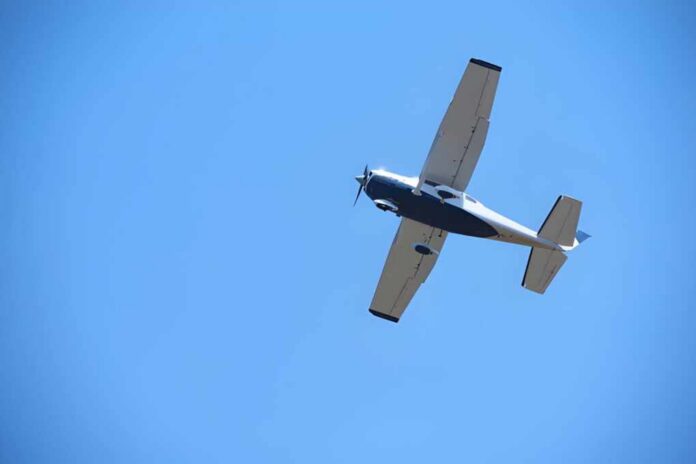
A Cessna Citation 560 business jet left Elizabethton, Tennessee, heading to Long Island, New York, with a pilot, a father, his young daughter, and her nanny on board. The jet climbed toward cruising altitude and followed its planned route. Then the pilot stopped answering air traffic controllers. Radar showed the plane calmly tracking its waypoints at high altitude, but no one inside was responding. From the ground, it looked normal. Inside, it was already a disaster.
Federal officials scrambled F-16 fighter jets to intercept after the unresponsive aircraft entered restricted airspace near Washington, D.C. When military pilots pulled alongside the jet, they saw the Citation’s pilot slumped over in his seat, not reacting to radio calls, maneuvers, or warning flares. The cabin showed no signs of panic or movement. The plane kept flying straight, controlled only by its autopilot system. For many minutes, modern technology kept the jet aloft while the people inside were likely already unconscious.
What investigators say really brought the jet down
The National Transportation Safety Board’s final report concluded that the most likely cause was hypoxia, a lack of oxygen, due to cabin depressurization. Hypoxia can creep up on pilots at high altitude, dulling their thinking before they realize something is wrong. Without quick action to use supplemental oxygen, a pilot can pass out and lose control. In this case, the board said the pilot probably became incapacitated during the climb, leaving the autopilot to fly the route until fuel ran low and the jet finally descended into a fatal spiral.
Investigators did not find a single clear mechanical failure that explained the loss of pressurization. Instead, they uncovered a pattern of neglected safety steps. The report said the Citation had several overdue maintenance inspections and was being flown without supplemental oxygen available in the cabin. Some unresolved issues involved the emergency oxygen system itself. If a low-oxygen event happened, the system might not have worked. The board listed the pilot’s and owner’s decision to operate without supplemental oxygen as a contributing factor to the crash. That choice turned a survivable problem into a certain tragedy.
A descending spiral on a Virginia mountainside
After passing near Washington, the ghost flight could not continue forever. Flight data showed that around 3:22 p.m., the jet abruptly left its steady cruise and entered a rapid descending spiral over remote, mountainous terrain in Virginia. With no conscious pilot to stabilize it, the aircraft slammed into the George Washington National Forest near Montebello at about 3:23 p.m., destroying the jet and killing all four people. Local authorities reached a burned crash site in rugged woods. There were no survivors, only wreckage and questions.
For the daughter who later spoke out, the horror was not just the violent end but the idea that her family spent their final moments unaware, victims of a technical failure and human decisions far beyond their control. She learned from investigators that the jet had gone down in a tight, descending spiral, a classic sign that no one was fighting the controls. That detail made clear this was not pilot error in the usual sense, but a case where the pilot was simply gone as a thinking, acting person.
Why this crash fuels wider anger about safety and the “elite” system
This accident fits a troubling pattern in private aviation where wealthy owners fly powerful jets while cutting corners on maintenance and safety gear. In past hypoxia crashes, like the 1999 Learjet accident that killed golfer Payne Stewart, investigators also pointed to pressurization problems and missed chances to use emergency oxygen. When regulators depend on owners to do the right thing, gaps appear. Ordinary families pay the price when complex machines are trusted to a mix of profit motives, paperwork, and faith that “it will be fine.”
Many Americans on the left and the right see stories like this as proof that the system serves the powerful first. A family flew on a sleek business jet, assumed safe by default, while maintenance issues went unresolved and emergency oxygen was not guaranteed. Federal agencies investigated after the fact, but no government watchdog stopped the flight before it left the ground. For people already worried about a distant “deep state,” this looks like another example of a safety net that is thin, slow, and tilted toward those who can afford risk.
What this means for everyday travelers and families
For regular travelers, this crash is a reminder that technology alone cannot replace basic safety habits. Pressurized aircraft need strict maintenance, clear rules about supplemental oxygen, and pilots trained to spot and react to hypoxia in seconds. When those layers fail, even a calm, routine flight can turn into a ghost plane. Families who step onto private jets or small planes trust unseen systems to protect them. If those systems bend to cost-cutting and weak oversight, heartbreak like this can follow.
For a growing number of Americans, the lesson is simple but heavy. They see a government that can scramble fighter jets and track a ghost flight across states, but cannot ensure every aircraft in the sky has its safety basics in order. That gap feeds the feeling that elites play by different rules, while ordinary people live with the risks. In the end, one father and his little girl never made it home, not because no one knew the dangers, but because the warnings were ignored until it was too late.
Sources:
nypost.com, youtube.com, cnn.com, pbs.org, reuters.com, facebook.com