

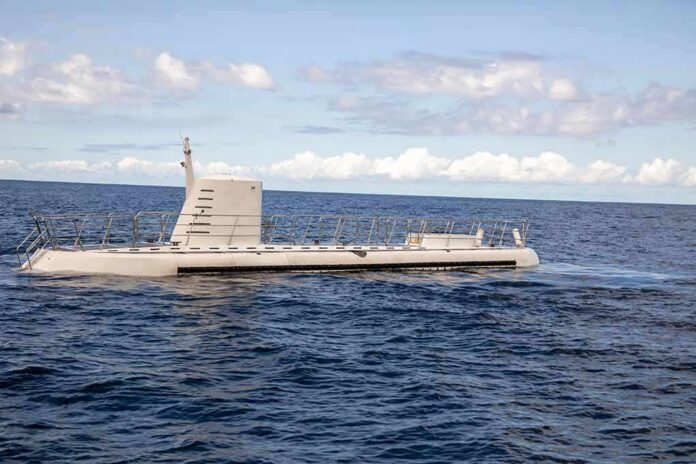
Iran says it seized a U.S. underwater drone near the Strait of Hormuz as the Pentagon says the craft had already failed, raising fresh questions about control, competence, and credibility in a vital waterway.
Story Snapshot
- Iran’s Revolutionary Guard Corps said it captured a U.S. unmanned underwater vehicle near the Strait of Hormuz.
- U.S. Central Command said the drone was an older model that malfunctioned more than a day earlier.
- Reports identified the vehicle as an Anduril Dive-LD autonomous underwater system.
- Both sides offered limited proof, leaving gaps that fuel public distrust and information warfare.
What Each Side Says Happened
Iran’s Islamic Revolutionary Guard Corps said its naval forces captured a modern U.S. unmanned submarine at the entrance to the Strait of Hormuz. Iranian outlets described a complex operation and suggested the craft was brought into Iran. Reuters reported the claim and noted the location and timing near the vital chokepoint. U.S. Central Command countered that an underwater drone malfunctioned more than a day earlier and was already disabled, framing the event as recovery, not interception.
The Pentagon’s message stressed that the vehicle was an older model that neither collected sensitive data nor carried classified sonar or radar gear. Business Insider echoed that U.S. officials said the drone was “dead in the water,” which would undercut any claim of an active, contested capture. This narrow, consistent U.S. line aims to lower the stakes and deny any major intelligence loss. It also avoids confirming Iran’s narrative of a dramatic takedown.
What Kind of Drone Are We Talking About?
Multiple reports identified the vehicle as an Anduril Dive-LD. This platform maps the seafloor, supports mine countermeasures, and can scout routes for ships, according to defense-focused coverage citing U.S. Navy use cases. These craft are designed to be “attritable,” meaning they can be lost without grave harm to national secrets. That point backs the U.S. claim that this particular unit did not carry sensitive or classified sensors. The identification gives the story concrete hardware, not rumor.
Still, some Iranian statements framed the drone as cutting-edge and recently delivered, which clashes with the U.S. description of an older, non-sensitive model. Without verified photos, serials, or a shared chain of custody, the public must weigh two narratives. The absence of hard proof keeps the debate alive and invites spin. That vacuum is common when small, unmanned systems go missing in contested zones and recovery happens out of public view.
Why the Strait of Hormuz Makes This Bigger
The Strait of Hormuz is a pressure point for global energy and for military signaling. Past months brought ship attacks, warnings about navigation interference, and rising risk levels from maritime monitors. Reuters and others have tracked electronic disruptions and vessel seizures around the strait in recent years, turning each incident into a test of resolve and perception. That setting makes even one disabled drone a tool for messaging, not just a hardware loss.
Electronic warfare and navigation spoofing reports in the region add fog and speed to events. Claims can harden before facts do. Governments know this and shape early headlines to their advantage. Iran’s state media can amplify a capture claim to show strength. U.S. officials can minimize the event to show control and protect programs. Both approaches feed a wider sense that authorities manage narratives first and share details later.
What Iran Could Gain — And What It Likely Cannot
If Iran has the vehicle, it could study hull design, propulsion, and commercial-grade sensors. It could learn about endurance profiles and mission planning methods. That knowledge can still help counter similar systems or speed domestic copies. But U.S. statements that the drone was older and carried no classified tech, if accurate, limit any high-end intelligence haul. Reverse engineering would then yield incremental gains, not a leap in undersea warfare.
🇮🇷🇺🇸 | IRGC claims capture of U.S. underwater drone Iran’s IRGC Navy says it ambushed and seized a classified U.S. underwater vessel in the Strait of Hormuz. Tehran claims the 2025 craft was captured intact and will soon be showcased on state TV. #Iran #US #StraitOfHormuz pic.twitter.com/6iIKFmD5Td
— TRIO-POLL (@triopoll) September 10, 2026
The larger gain for Iran may be information leverage. A “capture” headline can raise the political cost for U.S. patrols and unsettle shipping and insurance markets. The narrative also plays to regional audiences and partners. For Washington, the risk is not one drone, but the pattern. Each disputed incident strains credibility with the public at home, where many already feel leaders hide failures and protect insiders over citizens’ interests.
Bottom Line for Americans
Officials on both sides are shaping a story in a critical waterway while facts lag. Iran says it seized a prized U.S. asset. The Pentagon says it was an old, broken tool with nothing secret on board. Both can be partly true, and both serve a message. Until verified images and records appear, treat extreme claims with care. The bigger concern is a system that rewards spin over clarity, while trade routes and energy prices sit in the balance.
Sources:
youtube.com, reuters.com, english.ahram.org.eg, iranintl.com, ua.news, bloomberg.com, notus.org, europesays.com