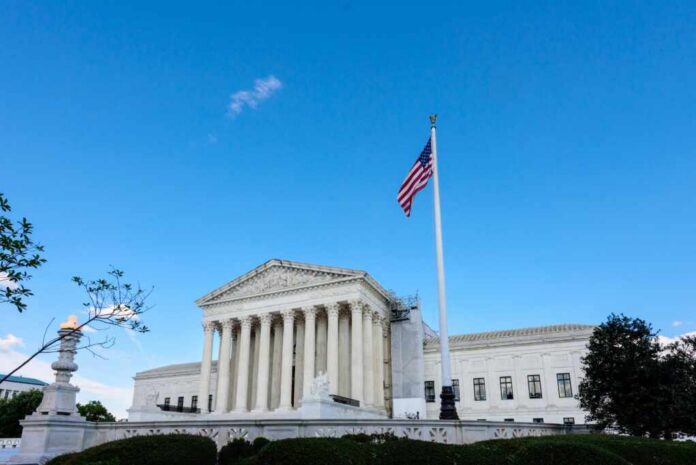
Supreme Court justices prepare to decide if federal law strips Second Amendment rights from millions of medical marijuana users in legal states, testing the limits of gun ownership protections.
Story Highlights
- Supreme Court hears arguments March 2, 2026, in United States v. Hemani on 18 U.S.C. §922(g)(3), banning guns for “unlawful users” of controlled substances like marijuana.
- Ali Hemani, charged after FBI found pistol and 60 grams of marijuana at his Texas home, argues the law violates Second Amendment post-Bruen.
- 5th Circuit ruled the ban unconstitutional for non-intoxicated users; Trump DOJ defends it citing public safety history.
- Impacts 6 million medical marijuana patients in 40 states and 43 states’ similar laws, pitting federal drug policy against gun rights.
Case Origins and Defendant’s Challenge
FBI agents searched Ali Danial Hemani’s Texas home and discovered a 9mm pistol, 60 grams of marijuana, and cocaine. Hemani admitted weekly marijuana use but surrendered the gun. Federal prosecutors charged him under 18 U.S.C. §922(g)(3), prohibiting firearm possession by unlawful users of controlled substances. Hemani contested the charge, claiming the law infringes Second Amendment rights, especially absent intoxication. The U.S. Court of Appeals for the 5th Circuit dismissed the case, deeming the ban unconstitutional for non-intoxicated users in rulings like Connelly.
Historical Roots of the Gun Ban
Congress enacted §922(g)(3) in the 1968 Gun Control Act to bar firearm possession by those addicted to or unlawful users of controlled substances, including federally illegal marijuana. The law traces to traditions disarming habitual drunkards and drug users deemed threats to public safety. Despite marijuana legalization in 40 states for medical use, federal law overrides state programs. Gun shops like Presque Isle cannot sell to medical users under federal rules, creating conflicts for law-abiding citizens exercising state-legal rights.
Supreme Court Takes Up the Fight
The Supreme Court granted certiorari on October 20, 2025, scheduling oral arguments for March 2, 2026, in this second gun-rights case of the term. Solicitor General D. John Sauer argues the law aligns with historical precedents for disarming dangers and applies temporarily to habitual users, reversible upon cessation. The Trump administration defends it despite strong Second Amendment support, highlighting an unusual alliance with gun control and anti-drug advocates against 2A challenges.
Key Arguments from Both Sides
Hemani’s counsel, ACLU’s Brandon Buskey, contends the statute’s vagueness lacks historical tradition for disarming occasional, non-intoxicated users, failing Bruen’s history-and-tradition test. DOJ counters with 60 years of precedent and risks of drug-related violence. Experts like Jacob Blocher call it the first major test of categorical disarmament post-Bruen. Law enforcement voices, such as Erie Police Chief Rick Lorah, emphasize common-sense safety concerns with drugs and guns.
Supreme Court to weigh legal battle over federal gun ban for drug usershttps://t.co/MajBTuN9Xy
— MSN (@MSN) March 1, 2026
Stakes for Gun Owners and States
A ruling striking the ban could disrupt similar laws in 43 states plus D.C., straining DOJ restoration processes and opening doors to broader challenges against categorical prohibitions like felon bans. Medical marijuana patients, gun owners in legal states, and the firearms industry face uncertainty. Long-term, it heightens federal-state divides on cannabis while testing Trump-era balances between individual liberty, public safety, and limited government overreach into personal choices.
Sources:
Supreme Court poised to weigh legal battle over federal gun ban for drug users
Supreme Court Weighs In On Major 2nd Amendment Cases
Supreme Court to consider legality of gun bans for marijuana users
Court to hear argument on whether and when drug users may possess firearms