Republican senators are pushing a $400 million taxpayer-funded White House ballroom project despite President Trump’s explicit campaign promise that no public money would be used for the construction.
Story Snapshot
- Senators Lindsey Graham, Katie Britt, and Eric Schmitt unveiling legislation to authorize $400 million for Trump’s East Wing ballroom
- Project funding excluded from reconciliation package after Democratic opposition blocked party-line passage
- Trump previously pledged the ballroom would use private funds, not taxpayer dollars
- Senator Rand Paul proposing alternative bill requiring no new taxpayer costs through committee oversight
Broken Promises and Taxpayer Burdens
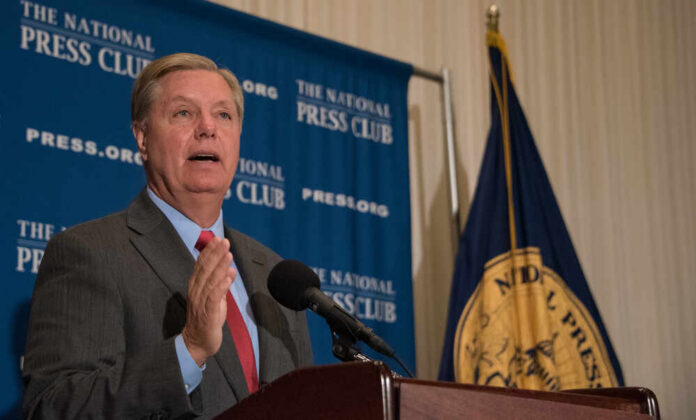
Senator Lindsey Graham announced plans to introduce legislation authorizing up to $400 million in federal funds for a presidential ballroom in the White House East Wing. The South Carolina Republican, joined by Senators Katie Britt of Alabama and Eric Schmitt of Missouri, scheduled a news conference for April 28 to unveil the bill. This development directly contradicts President Trump’s campaign assurances that such White House modernization projects would rely exclusively on private funding rather than burdening taxpayers. The contradiction raises fundamental questions about accountability when elected officials abandon pledges made to voters.
Political Maneuvering After Reconciliation Failure
The push for standalone legislation follows the failure to include ballroom funding in a party-line reconciliation package, which Democrats successfully blocked. GOP senators are now pursuing multiple pathways to advance the project. Senator Tim Sheehy of Montana announced plans for a separate bill seeking unanimous consent on the Senate floor, while the Graham-led effort aims for traditional legislative authorization. These parallel strategies reflect the challenge Republicans face in advancing the project without Democratic support or the procedural advantages of budget reconciliation. The maneuvering exposes how difficult governing becomes when bipartisan cooperation collapses entirely.
Fiscal Conservative Resistance Emerges
Senator Rand Paul, chairman of the relevant Senate Homeland Security Committee, is crafting alternative legislation that would authorize the ballroom project without imposing new taxpayer costs. Paul’s approach represents fiscal conservative concerns within the Republican caucus about adding $400 million to federal spending amid ongoing national debt debates. His committee role gives him gatekeeper authority over the project’s advancement, creating internal party tension between Trump loyalists eager to deliver presidential priorities and budget hawks committed to fiscal restraint. This split illustrates the persistent divide between establishment Republicans willing to spend and principled conservatives demanding fiscal responsibility.
Historic Precedent and Elite Disconnect
The proposed $400 million ballroom dwarfs previous White House renovation expenditures, including Truman-era upgrades and Reagan-era modernizations that together cost far less in inflation-adjusted dollars. Past presidential residence improvements generated controversy at much lower price points, including an Obama-era tennis pavilion criticized at $500,000 and disputed Biden-era green upgrades. The current proposal arrives as millions of Americans struggle with inflation, high energy costs, and diminished economic opportunities. Spending nearly half a billion dollars on an elite event space while ordinary citizens face economic hardship reinforces the perception that Washington politicians serve themselves rather than the people who elected them.
Lindsey Graham Says He’s Proposing Bill to Spend $400 Million on Trump’s Ballroom https://t.co/db6evQ1fkM
— Mediaite (@Mediaite) April 28, 2026
The National Capital Planning Commission will oversee any approved construction, but the fundamental issue remains whether federal resources should fund luxury presidential amenities during a period of national fiscal strain. Democrats have unified in opposition, framing the expenditure as wasteful, while some Republicans quietly share those concerns despite party loyalty pressures. The episode demonstrates how both parties contribute to government dysfunction, with Republicans breaking spending promises and Democrats offering obstruction rather than solutions. Americans across the political spectrum increasingly recognize that elected representatives prioritize their own interests and political survival over addressing the serious economic and social challenges facing working families.
Sources:
Ballroom funding in party-line package a no-go – Politico
MAGA Stooge Lindsey Graham Reveals Major Plot Twist for Trump’s Ballroom – The Daily Beast