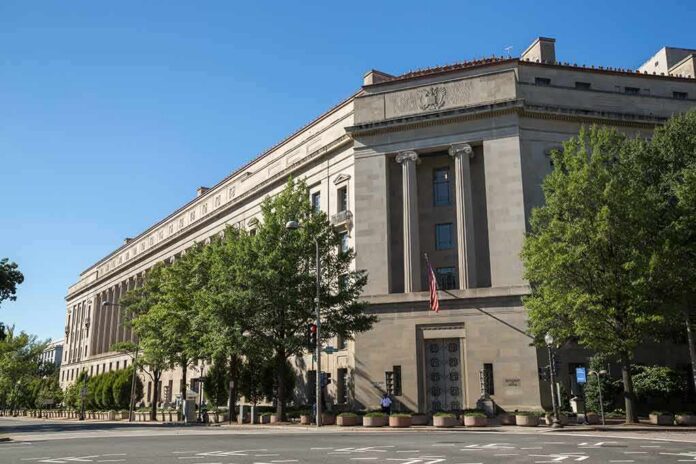
OpenAI has agreed to pay $3.2 million after the United States Department of Justice said the company favored temporary visa holders over American workers in hiring.
Quick Take
- The Justice Department announced a combined $3.2 million settlement with OpenAI OpCo LLC and Statsig Inc.
- Officials said the companies discriminated against U.S. workers during Permanent Labor Certification recruitment.
- The department said OpenAI did not post some openings on its public job site and used paper applications.
- The settlement requires changes to OpenAI’s hiring process and includes money for penalties and victim pay.
What the Justice Department said happened
The Justice Department’s Civil Rights Division said its investigation found that OpenAI treated Permanent Labor Certification jobs differently from its normal openings. The department said the company did not advertise those roles on its external job site, even though it usually posted other jobs there. It also said OpenAI required paper applications by mail for those positions, while accepting electronic applications for other roles.
The department said those steps made it harder for U.S. workers to apply and gave temporary visa holders an edge. Under the settlement, OpenAI will pay $1.2 million in civil penalties and create a $2 million back-pay fund for victims. It must also post Permanent Labor Certification jobs on its public career site, accept electronic applications, and follow training and monitoring rules.
Why this case matters beyond OpenAI
The OpenAI deal fits a broader enforcement push around hiring tied to the Permanent Labor Certification process. In this system, employers can seek foreign workers for certain jobs, but they still must give U.S. workers a fair chance to apply. The case shows how the Justice Department is focusing on whether companies make those openings easy to find or quietly harder for domestic applicants to see.
Wall Street Journal reporting said OpenAI disagreed with the Justice Department’s findings but settled anyway to close the case. That matters because settlements do not decide guilt in court, but they do show where federal officials see a legal risk. For workers, the dispute also touches a bigger frustration that cuts across party lines: many people believe the system often feels built for large firms first and local job seekers second.
What the settlement changes going forward
According to the Justice Department, OpenAI must change how it handles these job postings and keep its personnel trained on anti-discrimination rules. The company will also face department monitoring and reporting requirements. Those steps suggest the government wants more than a one-time payment. It wants a lasting change in how a high-profile artificial intelligence company recruits for jobs linked to immigration sponsorship.
JUST IN: 🇺🇸 OpenAI hit with a $3.2M DOJ settlement over hiring bias — accused of favoring visa holders over US workers in green card recruitment.
⚡ $1.2M penalty + $2M back-pay fund; pic.twitter.com/g2XF9jjegk
— CoinMarginalX (@CoinMarginalX) August 4, 2026
The case lands at a time when job security, immigration, and the power of major technology firms are already under a microscope. Supporters of stricter hiring rules will likely see the settlement as proof that federal law still has teeth. Critics may see it as another sign that companies with deep legal teams can settle fast and move on while ordinary workers rarely get that kind of leverage.
Sources:
redstate.com, justice.gov, wsj.com