
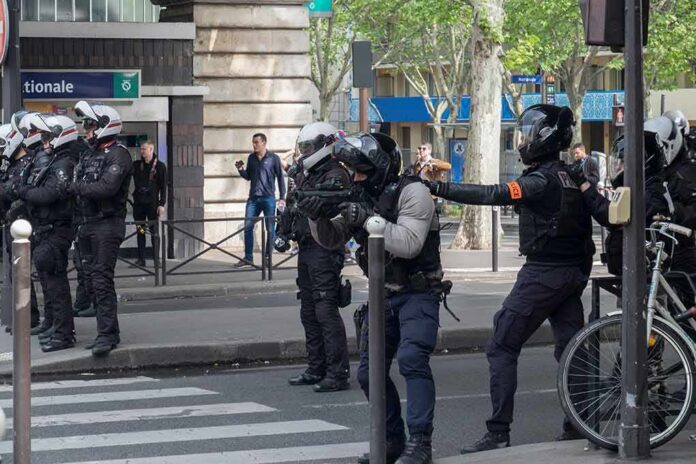
France flooded Orléans with nearly 3,000 officers, armored vehicles, and drones as thousands marched against the National Rally congress.
Story Snapshot
- Thousands protested in Orléans against the National Rally as police mounted a major operation.
- Authorities counted about 11,000 protesters; organizers said 26,000, highlighting a gap in estimates.
- About 50 parties, unions, and groups backed the march, using anti-racist and anti-fascist messaging.
- Police made arrests during wider protests across France; the Orléans march ended peacefully earlier in the day.
Large Anti-Rally March Confronts Party Congress
Protesters filled Orléans streets on the day the National Rally opened its party congress. France 24 described the crowd as thousands of anti-fascist protesters who marched to oppose the party led by Marine Le Pen. The prefecture reported about 11,000 people by midday, while organizers claimed more than twice that number, underscoring a dispute over turnout size. Marchers carried signs and chanted against racism and fascism as the congress proceeded nearby under tight security.
Euronews reported that nearly 3,000 police and gendarmes were deployed in the city, with armored vehicles, helicopters, and drones in use. Local officials suspended some transport, and businesses boarded windows as a precaution. Authorities framed the weekend as a public order test as similar protests were expected across the country. The large security footprint showed how seriously the state treated the risk of clashes near the high-profile gathering of the National Rally.
Broad Coalition Drives Anti-Fascist Messaging
Euronews said about 50 political parties, unions, and civil groups called people to the march, uniting around themes of opposition to racism, fascism, and imperialism. Reports described clear anti-racist and anti-fascist slogans and signs in the crowd. The head of a major labor union, Sophie Binet, argued the National Rally is not a normal party in a democracy and used strong language to condemn it, reflecting a long-running clash over the party’s place in French politics.
The messages in Orléans also mixed with other current grievances. Coverage linked the mobilization to anger over the rising cost of living, education funding, and limits on protest rights, which have fueled recent unrest nationwide. This broader list of complaints helped turn the event into a wider show of opposition but made it harder to pin every sign or chant to one single issue. Still, the central target on this day was the National Rally congress.
Arrests Elsewhere, Peaceful End in Orléans
Across France, authorities made arrests and used tear gas in some places as a new round of protests unfolded. National figures cited by reporters put arrests in the triple digits over the wider weekend, showing the scale of the unrest beyond Orléans. In Orléans itself, the march ended peacefully earlier in the afternoon, according to reporting, even as police remained ready near the site of the congress in case of later flare-ups.
The turnout debate shows how protest metrics can become part of the political fight. The prefecture’s 11,000 estimate and the organizers’ 26,000 claim point in different directions and invite arguments over momentum and public backing. What is not in doubt is the scale of the state response and the breadth of the coalition on the streets. Those facts show deep tensions over immigration, identity, and power in France as parties test the limits of democratic competition.
Sources:
facebook.com, france24.com, cnn.com, euronews.com, cbsnews.com, tribuneindia.com