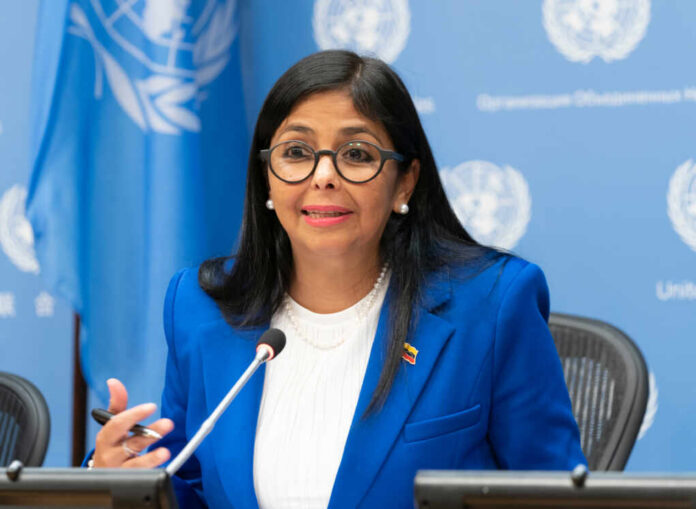
Venezuela’s interim leader stands defiant, rejecting U.S. interference as tensions escalate.
Story Highlights
- Delcy Rodriguez, interim president, criticizes U.S. influence in Venezuela.
- U.S. operations in Venezuela include capturing ex-President Maduro.
- Rodriguez assumes leadership amid regional instability.
- Oil reforms and prisoner releases highlight ongoing U.S. pressure.
Rodriguez’s Defiant Stance Against U.S. Influence
On January 25, 2026, Delcy Rodriguez, Venezuela’s interim president, delivered a powerful speech in Anzoátegui state, condemning U.S. interference in Venezuelan politics. Her address to oil workers emphasized the need for Venezuela to resolve its own issues without foreign intervention. This statement comes in the wake of heightened tensions following the recent U.S. military actions in the region, including the capture of former President Nicolas Maduro.
Rodriguez’s strong rhetoric reflects a broader sentiment of national sovereignty, which resonates with Venezuelans weary of external control. She called for unity among Venezuelans to address internal conflicts, advocating for domestic solutions over foreign dictation. This approach highlights her efforts to gain legitimacy and support from the Venezuelan populace amid the challenging political landscape.
'Enough orders from Washington,' Venezuela interim leader says in address https://t.co/XpB849AYGV pic.twitter.com/67yNF2Vmlp
— Insider Paper (@TheInsiderPaper) January 26, 2026
Impact of U.S. Military Actions on Venezuelan Politics
The capture of Nicolas Maduro by U.S. forces on January 3, 2026, marked a significant shift in Venezuelan politics. The operation, which involved the use of advanced military technology, has been met with both applause and criticism. The U.S. military’s actions have intensified debates over sovereignty and control, as Rodriguez navigates the complexities of leadership post-raid. Her presidency began in this climate of upheaval, with the former vice president stepping into the role amidst external pressures.
The U.S. holds considerable leverage in Venezuela through control of oil sales and economic influence. This control is seen in the $300 million transfer from U.S.-sold oil, which is intended to benefit the Venezuelan people. However, this dependency raises concerns about long-term sovereignty and economic independence, as Rodriguez attempts to balance U.S. demands with national interests.
Ongoing Reforms and Human Rights Developments
In a move aligned with U.S. interests, Venezuela has initiated oil sector reforms, notably the signing of the Hydrocarbons Law under U.S. pressure. This legislation aims to restructure the oil industry, fostering economic recovery while increasing reliance on U.S. partnerships. Additionally, over 100 political prisoners have been released, a development confirmed by human rights organizations such as Foro Penal. These actions represent a cautious response to U.S. influence, as Rodriguez seeks to maintain both international relations and domestic stability.
The prisoner releases signify a step toward reconciliation and political reform, yet they also highlight the ongoing challenges Rodriguez faces in asserting Venezuelan sovereignty. The interplay between U.S. control and internal governance remains a critical issue, with long-term implications for the nation’s political landscape and economic future. As Rodriguez continues to push back against foreign orders, the path forward for Venezuela remains uncertain, shaped by both internal dynamics and external pressures.
Sources:
Venezuela Interim Leader: ‘Enough Orders from Washington’
Venezuela’s interim president condemns US pressure
Venezuela’s Delcy Rodriguez says she’s had enough of US orders
Venezuela’s interim leader pushes back against US pressure
Venezuela interim leader pushes back against US pressure
Venezuela interim leader says pressure from US since capture of Maduro