
The United States and Japan launched their largest Keen Sword drills to date, putting new U.S. anti-ship and air-defense systems on Japan’s island closest to Taiwan.
Story Snapshot
- U.S. and Japanese forces began major Keen Sword exercises across Japan’s southwest islands near Taiwan.
- U.S. Marines are deploying new anti-ship and air-defense systems to Yonaguni for the first time.
- Japan says the drills improve joint readiness, air defense, and island operations.
- A U.S. carrier strike group is supporting the exercise around Japan’s waters.
What Happened: Drills Expand Near Taiwan-Facing Islands
Japan and the United States started the Keen Sword exercise around Japan’s southwest island chain. These islands stretch toward Taiwan and sit astride narrow sea lanes. Japan’s Joint Operations Command planned training across bases, ports, and surrounding sea and airspace. The goals include command coordination, air and missile defense, sea control, and logistics between islands. Japan’s Self-Defense Fleet describes Keen Sword as a recurring event that grows alliance readiness and interoperability with like-minded partners. The drills involve maritime, air, and amphibious units over many days.
The United States Marine Corps is sending two new systems to the front line of the Nansei islands. The Navy-Marine Expeditionary Ship Interdiction System fires anti-ship missiles from mobile launchers. The Marine Air Defense Integrated System provides short-range protection against drones and aircraft. U.S. Marines plan to operate both on Yonaguni, the Japanese island closest to Taiwan, during the exercise. A Japanese defense planning document, cited in reporting, confirmed the deployments for this iteration.
Why It Matters: Island Defense and Deterrence
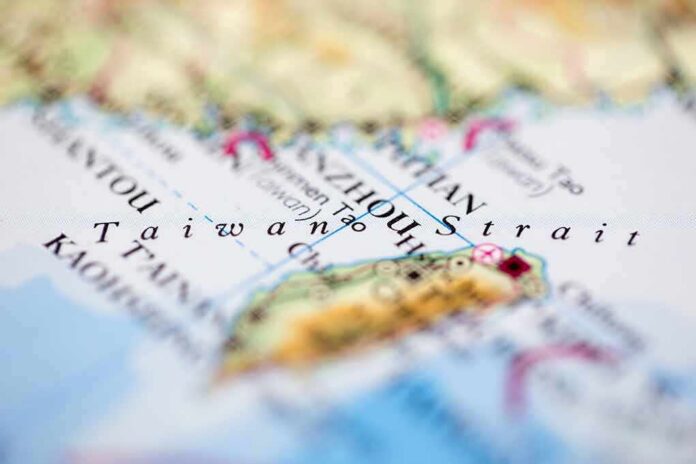
The location is the message. Yonaguni sits roughly 110 kilometers from Taiwan and near key straits that connect the East China Sea to the Pacific. Placing mobile anti-ship missiles and air defenses there tests rapid movement, sustainment, and joint targeting across scattered islands. It also signals the partners can complicate an enemy’s approach to these waters. The United States Navy has emphasized integrated maritime operations with Japan for years, and Keen Sword has steadily added air and missile defense and amphibious tasks since earlier iterations.
Scale underscores intent. Reports tied to Japan’s command figures describe tens of thousands of Japanese personnel and more than ten thousand Americans participating, alongside dozens of ships and hundreds of aircraft. The United States Navy’s Theodore Roosevelt carrier strike group moved to the region to support the event, adding carrier air power and escorts to the training picture. That mix lets air, sea, and shore-based forces practice working together under stress. It also reveals gaps in communications, logistics, and munitions that planners can fix now, not during a crisis.
The Bigger Trend: From Routine Drills to a Southwest Shield
Keen Sword began in the 1980s as a defense-of-Japan drill. Over time it shifted toward distributed island defense and integrated air and missile defense across the southwest arc. Japan has invested in new units, radars, and anti-ship missiles across the Nansei islands to harden this flank. The alliance has practiced amphibious operations and multi-domain targeting to make the island chain harder to penetrate. Analysts describe this as moving from a single main front to many smaller, connected points that deny access.
Recent steps by Japan add context. Government documents and public reporting describe deployments of longer-range missiles on Japan’s main islands and plans to bolster forces across the southern chain. These efforts aim to deter attacks and respond faster if trouble spreads from nearby hotspots. While details vary by source, the overall direction is clear: Japan and the United States are building a flexible shield in the southwest that blends sensors, shooters, and mobility across sea and air corridors.
What This Means for Americans: Cost, Risk, and Credibility
American taxpayers fund an Indo-Pacific posture that relies on allies who can hold their ground. Exercises like Keen Sword offer proof that joint plans are not just speeches. They also carry cost and risk. Moving new systems to forward islands requires steady funding, secure supply chains, and careful planning. When the government gets that wrong, troops face shortfalls, and the public pays more. When it gets it right, deterrence is stronger, and crises are less likely to spiral.
For many readers on the right and left, trust hinges on results. People worry about endless spending, unclear goals, and leaders who protect their jobs more than the nation’s priorities. Keen Sword is a hard test of real capability. Japan and the United States must show that forces can move fast, share data, and sustain operations across far-flung islands. If they can do that, it builds credibility without chest-thumping. If they cannot, it is better to learn it here than in a shooting war.
Sources:
defencesecurityasia.com, thebostonreport.com, mod.go.jp, note.com, 3g.china.com, eng.chinamil.com.cn, aljazeera.com