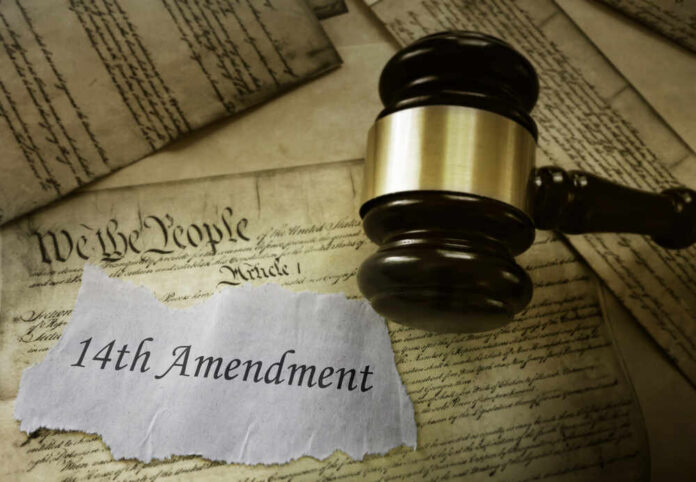
A 157-year-old constitutional provision designed to heal the wounds of slavery has become the flashpoint for America’s most contentious immigration battle, with the White House now claiming the power to reinterpret citizenship itself.
Story Snapshot
- Executive Order 14160 denies citizenship to children born in the U.S. to undocumented or temporary visa holders, challenging Supreme Court precedent dating back to 1898
- The 14th Amendment’s citizenship guarantee, ratified in 1868 to overturn Dred Scott and protect freed slaves, now faces its most aggressive reinterpretation in modern history
- Between 300,000 and 400,000 children born annually to non-citizen parents could lose automatic citizenship if the executive order survives legal challenges
- Congressional legislation introduced by Senator Lindsey Graham and Representative Brian Babin aims to codify citizenship restrictions through the Birthright Citizenship Act of 2025
The Constitutional Foundation Under Siege
The 14th Amendment’s Citizenship Clause emerged from one of America’s darkest chapters. Ratified on July 9, 1868, it declared that “all persons born or naturalized in the United States, and subject to the jurisdiction thereof, are citizens.” This language overturned the Supreme Court’s infamous Dred Scott decision, which had denied citizenship to Black Americans, and cemented birthright citizenship as a constitutional bedrock. The principle traces its roots to English common law, where being born on the sovereign’s soil automatically conferred subject status.
When the Supreme Court Settled the Question
The 1898 Supreme Court case United States v. Wong Kim Ark should have ended this debate. In a 6-2 decision, the Court ruled that children born on U.S. soil to non-citizen immigrant parents automatically receive citizenship, excluding only children of diplomats or invading military forces. Wong Kim Ark, born in San Francisco to Chinese laborers who could never naturalize under the racist Chinese Exclusion Act, became the test case. The Court’s ruling affirmed that the 14th Amendment meant exactly what it said, regardless of parental immigration status.
The Modern Attack on Birthright Citizenship
Executive Order 14160, signed in January 2025, represents the most aggressive attempt to rewrite constitutional citizenship since Reconstruction. The order reinterprets “subject to the jurisdiction thereof” to exclude children born to undocumented mothers or temporary visa holders when the father lacks citizenship or legal permanent resident status. This affects an estimated 10 to 20 percent of U.S. births annually, creating a new underclass of stateless children born on American soil. The White House claims it merely enforces existing law found in 8 U.S.C. Section 1401, but that statute describes who receives citizenship, not who can be constitutionally excluded.
The Legislative Push to Restrict Citizenship
Senator Lindsey Graham’s Senate Bill 304 and Representative Brian Babin’s House Resolution 569 seek to accomplish through legislation what the executive order attempts through executive fiat. The Birthright Citizenship Act of 2025 would limit automatic citizenship to children born to at least one parent who is a U.S. citizen or legal permanent resident. Sponsors frame this as closing loopholes that incentivize “birth tourism” and “anchor babies,” terms critics use to describe pregnant foreign nationals who travel to America specifically to secure citizenship for their children, allegedly creating a foothold for chain migration.
Constitutional Scholars Sound the Alarm
Legal experts across the political spectrum recognize the executive order faces insurmountable constitutional barriers. The Brennan Center for Justice points out that every branch of government has consistently interpreted the 14th Amendment to grant broad birthright citizenship for over a century. UC Davis Professor Gregory Downs notes that constitutional rights have never been self-enforcing and history reveals repeated attempts to undermine them. Even originalist interpretations struggle with the executive order’s reasoning, since Senator Jacob Howard, who helped draft the 14th Amendment in 1866, explicitly stated the citizenship clause was declaratory of existing common law.
The Ripple Effects Across American Society
Hospitals face immediate administrative chaos determining which newborns qualify for citizenship documentation. Immigration enforcement agencies must create new bureaucratic processes to track parental status at birth. Families with mixed immigration statuses confront the nightmare scenario of citizen children and non-citizen siblings born months apart. H-1B visa holders, students, and temporary workers who believed their American-born children would be citizens now face uncertainty. The economic arguments restrictionists make about reduced welfare costs remain unquantified in available data, while the social costs of family separation and potential minority disenfranchisement loom large.
Birthright Citizenship Is National Suicide https://t.co/OaMOsLnsJe
— zerohedge (@zerohedge) March 30, 2026
The phrase “national suicide” reveals the apocalyptic framing some restrictionists bring to this debate. Yet the true threat to national stability may be the precedent of allowing executive reinterpretation of clear constitutional text. If an administration can unilaterally redefine who qualifies for 14th Amendment citizenship protections, what other constitutional guarantees become negotiable through creative executive branch lawyering? The courts will decide whether Wong Kim Ark’s 127-year-old precedent survives this challenge, but the broader question remains whether American citizenship itself can withstand political winds that shift with each election.
Sources:
Protecting the Meaning and Value of American Citizenship – The White House
8 U.S. Code § 1401 – Nationals and citizens of United States at birth
Fourteenth Amendment, Section 1: Citizenship – Constitution Annotated
Birthright Citizenship Under the U.S. Constitution – Brennan Center for Justice
Birthright Citizenship Act of 2025: Bill Summary – Forum Together
A Brief History of Citizenship: The 14th Amendment to the U.S. Constitution – UC Davis
Know Your Rights: Birthright Citizenship – NAACP Legal Defense Fund