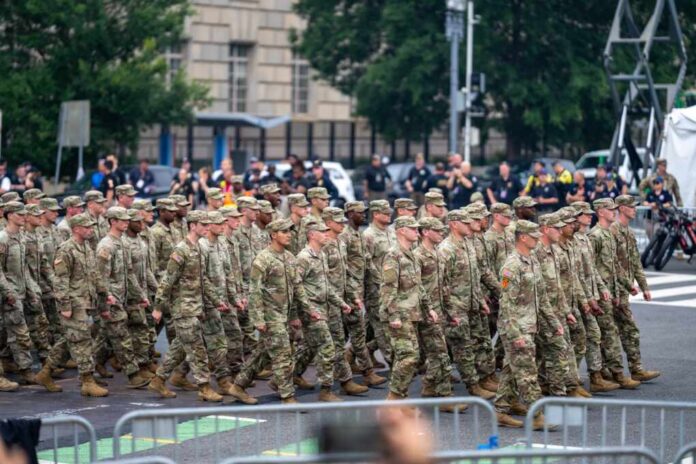
President Trump proposes a record $1.5 trillion defense budget, demanding contractors prioritize warfighters over Wall Street profits in dangerous times.
Story Highlights
- Trump’s $1.5T FY2027 budget marks 50% jump over 2026 levels, funded by tariffs to build a “Dream Military.”
- Executive order bans stock buybacks and caps executive pay at $5M for underperforming contractors like Raytheon.
- Republicans in Congress applaud the plan as vital to rebuild forces against China threats.
- Pentagon backs reforms to ensure funds reach troops, not shareholder payouts.
Trump’s Bold Budget Announcement
President Donald Trump announced on January 7-8, 2026, via Truth Social a $1.5 trillion defense budget request for fiscal year 2027. This represents a 50 percent increase over anticipated 2026 spending and a 66 percent rise above Congress’s recent $900 billion authorization for 2026. Trump described the funding as essential for a “Dream Military” amid “very troubled and dangerous times.” He plans to finance it through tariff revenues, aligning with his America First economic strategy that counters globalist trade policies.
Cracking Down on Defense Contractors
Trump issued an executive order on January 8 restricting defense contractors from stock buybacks and corporate distributions if they underperform on contracts. Executive compensation faces a $5 million cap for firms failing to deliver products or build modern facilities. Pentagon spokesperson Sean Parnell emphasized that contractors can no longer prioritize massive payouts over warfighter needs after years of missed obligations. This move restores accountability long eroded by corporate greed.
Trump specifically called out Raytheon, an RTX Corporation unit, as the least responsive, slowest to scale production, and most focused on shareholders over military demands. Defense stocks plunged following the criticism, signaling market recognition of needed reforms in an industry plagued by delivery failures on jets and submarines.
Hegseth tells defense contractors to ‘step up,’ warns Trump’s $1.5 trillion war budget is ‘a message to the world’ https://t.co/7xBt2HVuWp pic.twitter.com/JV4hr7Gi49
— New York Post (@nypost) January 12, 2026
Congressional Support Builds Momentum
House Armed Services Committee Chairman Mike Rogers (R-AL) hailed the proposal as the investment required to rebuild the military and restore U.S. leadership worldwide. Rep. Don Bacon (R-Neb.) labeled it a “good news story,” pushing for permanent defense spending at 4 percent of GDP to modernize Navy, Air Force, ICBMs, and bombers while supporting troops. OMB Director Russell Vought eyes reconciliation bills for passage, leveraging Republican unity to bypass Democrat obstruction.
The budget targets great-power competition with China, funding projects like the Golden Dome space defense, Golden Fleet naval expansion, and Boeing F-47 fighters. Experts at the Council on Foreign Relations note such increases address long-standing modernization needs against peer adversaries, though reforms must accompany spending to overcome industrial base shortcomings.
Fiscal Realities and Long-Term Strength
Preliminary estimates from the Committee for a Responsible Federal Budget project the plan adds $5.8 trillion to federal debt over 2026-2035, a serious commitment that prioritizes security over endless domestic overspending from prior administrations. Unlike Biden-era stagnation, this scales defense from 3.5 percent to higher GDP shares advocated by hawks. Taxpayers gain reassurance of strong deterrence, while allies see renewed American resolve. Implementation hinges on Congress, with current fiscal year bills still pending but expected to exceed Trump’s initial requests.
Watch:
Sources:
Air and Space Forces Magazine: 1.5T Defense Budget
Military.com: Trump’s $1.5T Defense Budget Protects Warfighters
Politico: Trump Calls for Record Defense Budget
Council on Foreign Relations: Trump’s $1.5 Trillion Defense Budget
Committee for a Responsible Federal Budget: $1.5 Trillion Military Budget Debt Impact
House Armed Services Committee: Statement on Defense Budget