A top Trump counterterrorism official just quit in the middle of a shooting war—warning Americans they’re being dragged into another Middle East conflict without a clear “imminent threat” to justify it.
Quick Take
- Joe Kent resigned March 17, 2026, as Director of the National Counterterrorism Center, the first public resignation tied to the Iran war.
- Kent said Iran posed no “imminent threat” to the United States and argued the war breaks with “America First” priorities.
- The White House rejected Kent’s claim, disputing his assessment without publicly detailing the underlying evidence.
- The conflict—described as a U.S.-Israel joint operation called “Operation Epic Fury”—was reported to be in its third week at the time of Kent’s resignation.
Kent’s Resignation Turns a Policy Dispute Into a Public Break
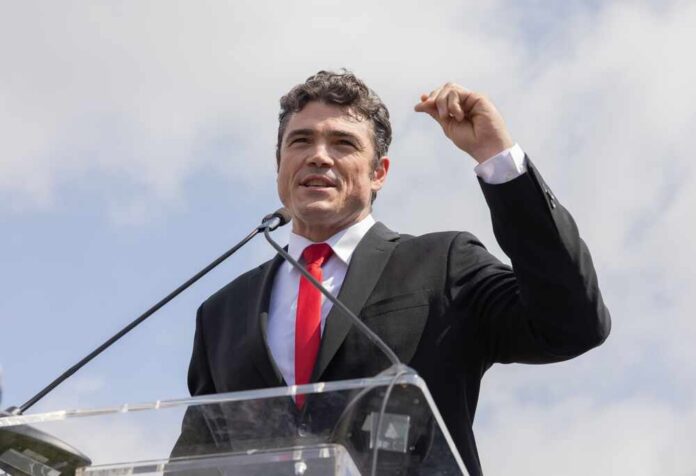
Joe Kent announced his resignation on March 17, 2026, releasing a public letter on X that framed his departure as a protest against the ongoing Iran war. Kent as Director of the National Counterterrorism Center and a senior Trump counterterrorism adviser, making his exit unusually high-profile for an internal national-security dispute. Kent argued the war lacked a necessary predicate—an “imminent threat” to the United States—while urging a return to tighter, targeted counterterrorism.
Kent’s break matters because it is not a backbench protest from the outside looking in. His role placed him at the center of counterterrorism and threat assessment, and his resignation forces the administration’s case for war into sharper focus: what, specifically, justified escalation, and what intelligence supported it?
What Kent Claimed—and What the White House Actually Answered
Kent’s letter, as reported, asserted Iran posed no imminent danger to Americans and contended the conflict was pushed by Israel and a pro-Israel lobby in the United States. Those are serious claims, but the public record is limited independent verification beyond Kent’s own statements. The clearest corroborated fact is that Kent made the allegation and resigned over it, not that outside evidence has confirmed his lobbying accusation.
White House Press Secretary Karoline Leavitt rejected Kent’s “no imminent threat” assertion, according to reporting, creating a direct contradiction between a departing senior official and the administration defending an active military operation. However, the recent coverage does not describe Leavitt presenting specific intelligence, a timeline of Iranian actions, or a documented imminent-threat threshold that would allow the public to weigh the competing claims. Without those details, Americans are left with dueling statements.
Operation “Epic Fury” and the Risk of Mission Creep
The conflict was described as a U.S.-Israel military action against Iran called Operation “Epic Fury,” reported to be in its third week when Kent resigned. Beyond that basic framing, the available research is thin on operational specifics—objectives, authorization, end state, or how success will be measured. That matters because modern wars tend to expand when goals are unclear. Conservatives who remember open-ended deployments know the pattern: limited action becomes a long commitment.
Why Kent’s Background Resonates With the “No More Endless Wars” Voters
Kent’s biography is central to why his resignation is landing with force: he reportedly served more than 20 years in the Army as a Green Beret with 11 combat tours, later worked for the CIA, and is a Gold Star husband whose wife, Navy Senior Chief Petty Officer Shannon Kent, was killed in a 2019 suicide bombing in Manbij, Syria. That record doesn’t prove his policy conclusions, but it explains why many voters treat his warning as more than politics.
Kent also framed his protest as a defense of the “America First” approach he supported earlier—using targeted force without sliding into broader regional wars. He previously backed Trump’s first-term posture against “never-ending wars,” while still supporting high-impact strikes like the 2020 killing of Qasem Soleimani. His critique, then, is not a blanket rejection of military action. It is a dispute about threshold, scope, and the cost-benefit to American lives and resources.
What This Means Politically—and What We Still Don’t Know
Kent’s resignation signals real strain inside a governing coalition that includes both non-intervention-leaning populists and more traditional hawks. In the short term, the most concrete impact is accountability pressure: if a senior counterterrorism official publicly disputes an “imminent threat,” the administration either clarifies the case or absorbs ongoing skepticism from its own base. In the long term, more departures—or congressional demands for specifics—could determine whether this becomes a contained operation or a wider, costlier fight.
CANDACE
JOE KENT TOLD THE TRUTH ABOUT THE IRAN WAR https://t.co/vay0hTCFkb— Steve Adams (@SteveAd13487346) March 18, 2026
For now, the facts are straightforward: Kent resigned on March 17, 2026; he publicly disputed the “imminent threat” premise; the White House publicly rejected his assessment; and the war was described as entering its third week. The biggest unknowns remain the details voters deserve before committing blood and treasure—what precise threat triggered this conflict, what “winning” looks like, and how the administration plans to prevent a limited mission from becoming another open-ended Middle East commitment.
Sources:
Trump’s Counterterrorism Director Resigns in Protest at Iran War
Top Trump counterterror adviser resigns over Iran war, says no ‘imminent’ threat