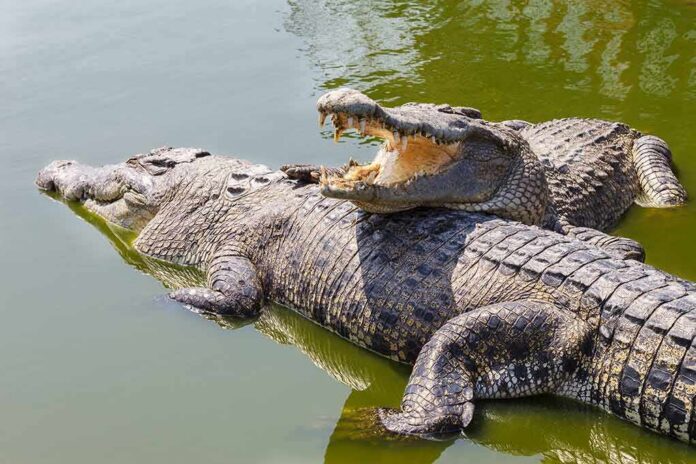
Israel just took a real legal step toward guarding Palestinian prisons with crocodile-filled moats, turning what sounded like satire into official policy.
Story Snapshot
- Israel reclassified Nile crocodiles so they can be used by security bodies around prisons holding Palestinian detainees.
- National Security Minister Itamar Ben-Gvir’s plan targets Ketziot Prison, a high-security facility for Palestinian prisoners including Hamas members.
- Nature and parks officials and rights groups warn the plan lacks evidence, breaks with wildlife protection rules, and amounts to psychological intimidation.
- The project has no published budget, timeline, or engineering plan yet, but moves the country further into extreme “security-first” politics.
What Israel Has Officially Changed
Environmental Protection Minister Idit Silman signed a new rule that changes how the law treats Nile crocodiles in Israel. Under the old rules, crocodiles could only live in licensed zoos for education or research. Silman’s decree now calls them a “specially managed” or “tended” wild animal, which means government security bodies, such as the Israel Prison Service, can keep them on prison grounds under certain conditions. This single legal move removed the main barrier that had blocked the crocodile moat idea up to now.
National Security Minister Itamar Ben-Gvir, a far-right figure who oversees the Israel Prison Service, first pitched the crocodile moat in a meeting with the prison commissioner last December. His proposal is to ring a prison with water-filled moats stocked with Nile crocodiles to make escape attempts far more dangerous and unlikely. The plan is not only about security; it also plays to his base by showing a tough stance toward Palestinian prisoners, including those accused of terrorism.
The Proposed Crocodile Prison and Its Model
Hebrew media and several international outlets report that Ketziot Prison in the Negev desert is marked as the pilot site for this project. Ketziot is a large, remote, high-security prison near the Egyptian border that holds many Palestinian security prisoners, including Hamas members captured after the October 7 attacks. The idea is to dig moats around the facility and bring in crocodiles from existing farms, creating a “living fence” that, in theory, would stop escapes without needing as many human guards.
Reports say Ben-Gvir’s team explicitly modeled the plan on the now-closed “Alligator Alcatraz” immigration detention center in the Florida Everglades. That U.S. facility used alligator-filled waterways as a deterrent around migrant detainees but shut down in June after controversy and criticism. By copying that design, Israeli officials claim there is a precedent for using predatory animals as a security tool. For many people, though, linking the plan to a failed experiment only makes it sound more reckless and extreme.
Warnings From Wildlife Officials and Rights Groups
Israel’s Nature and Parks Authority has openly opposed the crocodile moat plan. Its legal advisers say there is no professional justification, no modern precedent, and that the move may conflict with existing wildlife protection laws. They argue crocodiles should be protected as wildlife, not turned into tools of incarceration, and warn that keeping them at prisons could create serious risks to both the animals and nearby communities if something goes wrong.
The environmental protection ministry’s own legal adviser, Neta Drori, also said there was “inadequate professional and factual evidence” to support using crocodiles as a security measure. She noted that other than political claims from Ben-Gvir, there is no hard data showing crocodiles would prevent escapes better than cameras, fences, or more staff. Human rights groups go further. They describe the plan as psychological intimidation that targets already vulnerable detainees, many of whom have not been convicted, and they strongly object to using animals as instruments of fear and deterrence.
Where the Plan Stands and Why It Matters
Despite the legal change, the crocodile prison moat is not yet a done deal. The Israel Prison Service has not released official details on a timeline, engineering plans, or a budget. Media reports say prison officials have visited zoos to learn about crocodile handling and behavior, but no final construction decision has been made. Legal experts warn the decree itself could be challenged in court, since it was signed over internal objections and may stretch the intent of wildlife protection laws.
ISRAEL RECLASSIFIES CROCODILES TO CLEAR THE WAY FOR BEN-GVIR'S CROCODILE-MOAT PRISON
The Prison Service has visited zoos to study crocodile handling and concluded the waterways could cut security costs while increasing deterrence, Israeli media report.https://t.co/hy5URcFGWp
— TALi (@TaliNewsWire) July 18, 2026
This story speaks to a wider fear shared by many Americans watching from afar: that governments are drifting toward shock-based “security theater” instead of serious problem-solving. Israel’s move to turn wild predators into prison guards fits a pattern where political elites choose headline-grabbing stunts over careful policy grounded in evidence. Conservatives and liberals alike who worry about deep-state thinking, human rights erosion, and leaders using fear to stay in power see this crocodile moat plan as another sign that the system cares more about control than justice or basic decency.
Sources:
zerohedge.com, wset.com, turkiyetoday.com, youtube.com, echr-cpt.com, en.yenisafak.com, newarab.com, aa.com.tr