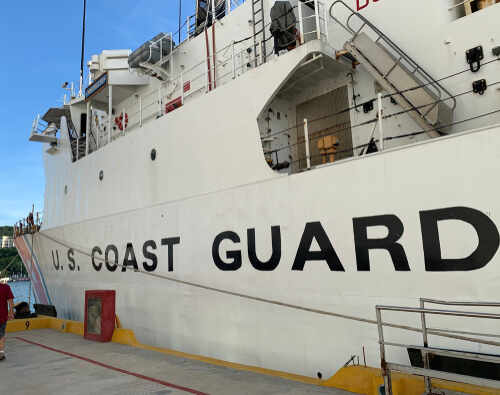
Washington politicians let DHS funding lapse, but President Trump moved to keep 41,000 Coast Guard service members paid anyway—highlighting how shutdown games still threaten the people protecting America’s shores.
Quick Take
- A partial Department of Homeland Security (DHS) shutdown began Feb. 14, 2026, after Congress failed to pass appropriations.
- The Coast Guard’s pay was at risk because it is funded through DHS, not the Pentagon, making it uniquely exposed during DHS lapses.
- The Trump administration used prior-year funding authority to continue pay for Coast Guard uniformed members and DHS law enforcement, blunting the most immediate harm.
- Coast Guard civilian employees still faced reduced pay—about half—during the lapse, even as many operations continued.
Shutdown politics collided with Coast Guard paychecks
The DHS funding lapse that began at 12:00 a.m. EST on Feb. 14, 2026, triggered a partial shutdown that immediately raised a basic question: would Coast Guard members who are required to keep working get paid on time. Reporting at the time put roughly 41,000 uniformed Coast Guard personnel in the crosshairs of the budget standoff, with a scheduled payday looming later in February. The uncertainty revived memories of prior shutdown-era missed checks.
Unlike most military branches, the Coast Guard sits under DHS during peacetime, so it depends on DHS appropriations rather than Defense Department funding. That structure can turn a Washington dispute into a kitchen-table crisis for military families even when cutters still sail and crews still respond to distress calls. During the 35-day DHS shutdown in late 2018, Coast Guard members missed paychecks, and accounts from that period included families relying on food banks.
Trump administration used prior-year funds to keep uniformed members paid
The immediate payday threat eased after the Trump administration announced it would continue paying Coast Guard uniformed personnel and DHS law enforcement using funds from the prior year’s tax-and-spending law. That executive action separated the Coast Guard’s active-duty pay from the day-to-day Senate procedural blockade, preventing the most visible and damaging outcome—service members in uniform not receiving a paycheck while still being ordered to report for duty.
The fix, however, was not universal across the workforce. Coast Guard civilian employees faced reduced compensation, with reporting indicating they were scheduled to receive about half of their normal pay during the lapse. That matters because civilians support readiness in concrete ways: maintenance, logistics, planning, and inspections that keep ships and aircraft safe and deployable. When civilians are underpaid or sent home, the operational cost does not vanish; it accumulates as delays and backlogs that take time and money to unwind.
Operational readiness took hits even as “excepted” missions continued
The Coast Guard continued “excepted” missions—search and rescue, law enforcement patrols, security operations, and hazardous-material response—because those functions protect life and national security. At the same time, routine patrols, fisheries enforcement, commercial vessel safety inspections, pilot and aircrew training, and maintenance activity were halted in varying degrees. Coast Guard leadership warned that the operational disruption can be measured in real assets sitting idle: grounded aircraft, static cutters, and a growing parts backlog.
Vice Adm. Thomas Allan, the Coast Guard’s vice commandant, warned lawmakers that interruptions in pay harm morale and readiness—especially in a service already facing staffing shortfalls. That warning is not an abstract management concern; recruiting and retention depend heavily on whether families believe the government will meet basic obligations. When Washington repeatedly flirts with missed pay, it signals instability to prospective recruits and imposes stress on current members who still have rent, utilities, fuel, groceries, and child care to cover.
Senate deadlock centered on immigration-enforcement demands
The shutdown was not just a generic spending fight. Reporting tied the continuing impasse to Democratic demands for changes to immigration enforcement policy that would have placed new restrictions on ICE operations, including requirements such as body cameras, use-of-force training mandates, and limits related to mask-wearing by agents. Democratic leaders indicated their caucus was aligned against moving DHS funding without those concessions, keeping procedural votes from advancing even after the House acted on DHS appropriations legislation.
Military family advocates argued that paycheck uncertainty during shutdowns becomes a repeating failure of governance, because retroactive back pay does not solve immediate bills. The Military Officers Association of America (MOAA) and the Military Coalition pressed Congress for more durable protections, including the Shutdown Fairness Act (S. 3168/H.R. 7137), which would guarantee pay for uniformed service members during funding lapses. As of early March 2026, ongoing Senate failure to move DHS funding to final passage.
Sources:
https://www.mycg.uscg.mil/News/Article/4409206/government-funding-lapse/