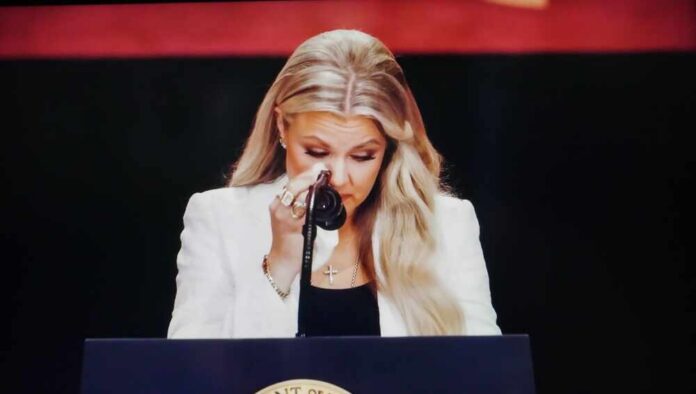
A viral “State of the Union tribute” storyline is spreading fast—but the best-sourced public records don’t back up the claim that Trump honored an “Erika Kirk” as Charlie Kirk’s widow in a 2026 address.
Quick Take
- No credible, English-language reporting in the provided citations confirms a 2026 State of the Union moment honoring “Erika Kirk” as Charlie Kirk’s widow.
- What is confirmed: Charlie Kirk was assassinated on Sept. 10, 2025, during a Turning Point USA event at Utah Valley University in Orem, Utah.
- The accused shooter, Tyler James Robinson, faces an aggravated murder case with prosecutors seeking the death penalty; pretrial litigation includes fights over graphic video evidence.
- The episode illustrates how quickly politically charged narratives can harden into “fact” online—especially when video clips and captions circulate without verifiable sourcing.
What the record supports—and what it doesn’t
Searchable, mainstream documentation in the provided research does not confirm the headline claim that President Trump “honored Erika Kirk” at a 2026 State of the Union and introduced her as the widow of Charlie Kirk, calling him a “Martyr of Freedom.” The citations supplied instead support a different, verifiable story: Charlie Kirk’s assassination in 2025 and the ongoing murder case. The research also flags that “Erika Kirk” is not established in those sources as Kirk’s spouse.
That gap matters because a State of the Union is a formal event with extensive transcripts, video archives, and broad press coverage. When a claim that dramatic lacks confirmation in the strongest available public references, the responsible conclusion is limitation—not certainty. Conservatives, more than most, understand how narrative framing can be weaponized; the fix is simple: separate what can be proven from what is trending, then demand documentation before repeating it.
What is confirmed about Charlie Kirk’s assassination
Multiple sources in the research agree on the core facts: Charlie Kirk, a conservative activist and Turning Point USA co-founder, was shot and killed on Sept. 10, 2025, at Utah Valley University during a TPUSA debate with roughly 3,000 attendees. The reporting describes a single shot striking Kirk in the neck from a long distance—figures vary from about 142 to 175 yards. President Trump publicly announced Kirk’s death later that day.
The timeline described in the research is unusually specific, reflecting how quickly the incident unfolded. The shooter allegedly reached a rooftop position near the Losee Center and fired around 12:23 p.m. Kirk was transported to a hospital almost immediately but was pronounced dead. After a manhunt lasting more than a day, the suspect surrendered. Those verified details, not viral captions, are the foundation for understanding what happened and why the case remains politically and culturally explosive.
The suspect, the charges, and the fight over evidence
The accused shooter is identified as Tyler James Robinson, a 22-year-old from Washington, Utah. The case includes aggravated murder charges, and prosecutors are seeking the death penalty, according to the research summary. The filings also reference additional allegations such as obstruction and witness tampering, with plea activity on at least one obstruction count while the murder case continues. The legal process is still active, meaning many key questions will be tested in court.
A major flashpoint is video evidence. The defense has sought to block videos of the killing, arguing that showing them would bias jurors—an argument that often appears in high-profile cases where viral footage is already circulating online. Courts must balance fairness for the accused with the public’s interest and the prosecution’s burden to prove guilt beyond a reasonable doubt. Whatever one’s politics, that tension is real—and it shapes what the public can see before trial.
Security failures and the broader political-violence climate
The sources also highlight security vulnerabilities at the event. One account notes that despite the presence of security and campus police, there was no screening—an uncomfortable detail for any movement that depends on public rallies, campus appearances, and open debates. For law-abiding Americans who value free speech and assembly, the lesson is sobering: constitutional rights are only as durable as the real-world protection surrounding them, especially when political temperatures run hot.
The research places Kirk’s killing in a larger pattern of political violence and instability across the country. That framing doesn’t prove motive in this specific case, but it does underscore why Americans are increasingly skeptical of institutions that preach “de-escalation” while tolerating demonization of opponents. The facts available here support heightened security and sober verification habits—not more rumor, not more algorithm-driven outrage, and not the casual acceptance of claims that can’t be corroborated.
Sources:
Defense seeks to block videos of Charlie Kirk’s killing in murder case, claims bias