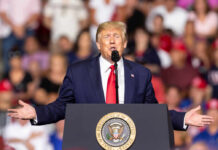


President Trump secures a strategic framework deal with NATO for permanent U.S. access to Greenland, countering Arctic threats from adversaries.
Story Highlights
- Trump announces “framework” agreement at Davos on January 22, 2026, after meeting NATO Secretary General Mark Rutte, shifting from tariff threats to diplomacy.
- Deal promises expanded U.S. military presence, resource access, and integration of Greenland into the Golden Dome missile defense system to bolster Arctic security.
- Builds on 1951 Defense of Greenland agreement for perpetual U.S. operations, reducing reliance on adversarial mineral suppliers like China.
- Denmark insists on sovereignty while open to security and economic talks; high-level working group formed for rapid negotiations.
Trump’s Davos Breakthrough
President Donald Trump announced the framework deal on January 22, 2026, during the World Economic Forum in Davos, Switzerland, following direct talks with NATO Secretary General Mark Rutte. The agreement outlines U.S. access to Greenland’s rare-earth minerals, expanded military basing, and placement of Golden Dome missile defense components. Trump emphasized perpetual arrangements, stating negotiations allow “anything we want” for security. This pivots from earlier tariff threats against opposing European nations, demonstrating Trump’s deal-making prowess in protecting American interests amid rising Arctic competition from Russia and China.
Watch:
Historical Foundations and Strategic Imperative
The U.S. has operated military facilities in Greenland since World War II under the 1951 Defense of Greenland agreement, which grants perpetual authority in designated areas. NATO’s 1955 status of forces agreement further enables free movement of American forces. Greenland’s strategic value surges with climate-driven shipping routes and vast rare-earth deposits critical for defense tech. Trump’s initiative counters adversary expansion, ensuring U.S. dominance without the globalist entanglements that weakened prior administrations. Vice President JD Vance and Secretary of State Marco Rubio met Danish and Greenlandic officials last week to lay groundwork.
Key Players and Negotiation Dynamics
Trump leads U.S. efforts, framing the deal as a national security necessity. Rutte supports swift resolution, targeting early 2026, with NATO commanders handling technical details. Danish Prime Minister Mette Frederiksen upholds sovereignty but welcomes talks on security, investments, and economy. Greenland, semiautonomous, raises autonomy concerns amid limited direct involvement. A high-level U.S.-Danish-Greenlandic working group now advances specifics, with Trump eyeing Danish clarity within two weeks.
Trump told reporters aboard Air Force One that evening that no written agreement exists yet, but terms aim for “forever” access. This structured diplomacy contrasts Biden-era hesitancy, prioritizing American sovereignty and resource security over endless multilateral debates.
U.S. President Donald Trump said he had secured total and permanent access to Greenland in a deal with NATO, whose head said allies would have to step up their commitment to Arctic security. https://t.co/x5v0D0aVMW
— The Japan Times (@japantimes) January 23, 2026
Impacts on U.S. Security and Economy
Short-term, the framework relieves transatlantic trade strains and enhances NATO Arctic capabilities against encroachment. Long-term, perpetual U.S. access reshapes geopolitics, slashing dependence on China for rare-earths vital to missiles, electronics, and green tech. Defense industries gain from infrastructure expansion; mining accelerates domestic supply chains. While sovereignty precedents like Guantanamo Bay offer models, Denmark’s firm stance ensures no territorial cession.
Negotiations continue, with Danish PM Frederiksen meeting Rutte on January 24. Trump’s approach delivers victories for patriots tired of weak leadership, fortifying America First in a contested world.
Sources:
ABC News: Trump’s framework Greenland deal
Atlantic Council: The future of Greenland and NATO after Trump’s Davos deal
Politico: Greenland negotiations resemble existing deal